Skip to content

What Type of Hydraulic Fluid Is Recommended for Mini Excavators?
What hydraulic fluid is recommended for mini excavators? Most mini excavators run best on anti-wear hydraulic oil rated ISO VG 46 in moderate climates. Cold-weather jobs typically call for ISO VG 32, while hot or heavy-duty conditions may warrant ISO VG 68. Your OEM manual has the final word — always check it first.
I’ve seen contractors pour the wrong hydraulic fluid into a brand-new mini excavator without thinking twice. Same story every time — they grabbed what was on the shelf, figured hydraulic oil is hydraulic oil, and moved on. Three months later, they’re dealing with a sluggish boom, a pump that whines like a wounded animal, and a repair bill that makes the eyes water.
Mini excavator hydraulic fluid isn’t some arbitrary specification buried in a manual nobody reads. It’s the single fluid your entire machine runs on. Every dig, every swing, every track movement — it all happens because pressurized oil is doing exactly what it’s supposed to do inside a tightly engineered system. Feed that system the wrong oil and you’re not just reducing performance. You’re quietly burning through components that cost thousands of dollars to replace.
Here’s what this guide covers: the exact type of hydraulic fluid most manufacturers actually recommend, why viscosity grades matter more than most people realize, how often you really need to change it, and the mistakes that field technicians see over and over again on job sites. Whether you run one compact machine or a whole fleet of them, this is practical information — the kind that saves you money in the long run.
Understanding Mini Excavator Hydraulic Systems
Here’s something a lot of operators don’t fully appreciate: a mini excavator is essentially a hydraulic machine that happens to have an engine. The engine’s job is mostly just to drive the hydraulic pump. Everything else—lifting, digging, swinging, traveling— runs on pressurized oil.
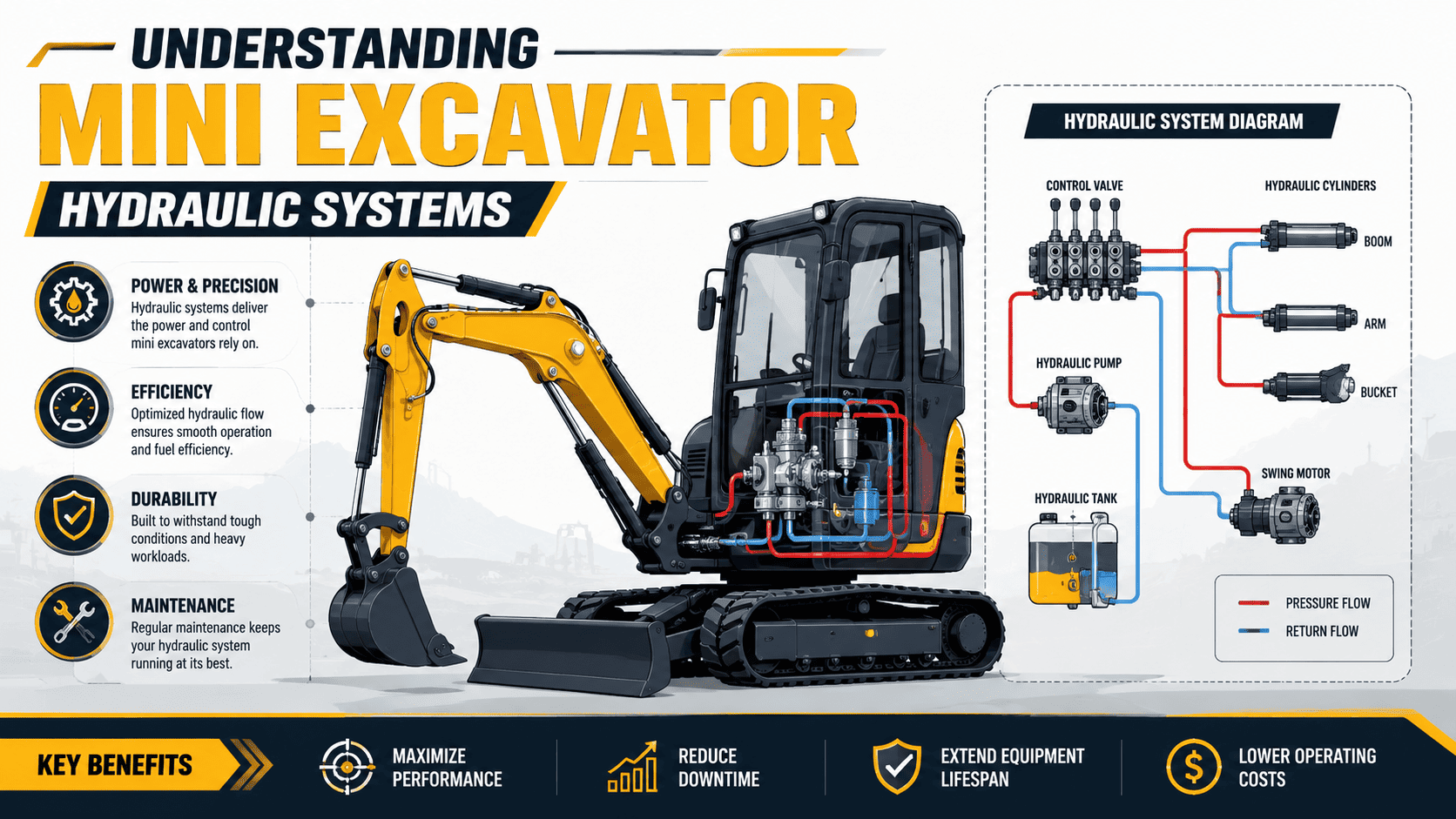
The pump pulls fluid from the reservoir and pushes it through a network of lines, control valves, and hoses. That pressurized fluid reaches the cylinders that move your boom, arm, and bucket, plus the motors that drive your tracks and swing the house. When you move a lever in the cab, you’re directing pressurized oil to do work. It’s a beautifully simple concept that becomes complicated fast when you factor in operating temperatures, pressure spikes, and the sheer number of components involved.
What the Fluid Is Actually Doing
At the hydraulic pump: The pump works with internal clearances measured in microns. The oil film separating moving metal surfaces inside that pump is the only thing keeping it from destroying itself. If it’s too thin, that film collapses under pressure. Too thick and the pump has to fight the fluid to move it, wasting energy and generating heat.
At the cylinders, your boom, arm, and bucket cylinders extend and retract thousands of times a day. The fluid has to lubricate the seals that keep pressure contained. Seals are made from specific elastomers that play well with certain fluid chemistries—and react badly to others.
At the motors: Track drives and swing motors convert hydraulic pressure back into rotation. These components are particularly sensitive to contamination. A little dirt in the fluid becomes an abrasive paste that grinds them down.
At the control valves: The spool valves that route oil to different circuits are precision-machined parts. Fluid that’s too thick makes them sluggish. Fluid that carries contamination can cause them to stick or wear unevenly.
Heat management: Hydraulic fluid also carries heat away from components. A fluid that’s breaking down thermally stops doing this effectively, which is why overheating and oil degradation tend to spiral together.
Knowing all this, it’s clearer why mini excavator hydraulic fluid isn’t something to guess on.
What Hydraulic Fluid Is Recommended for Mini Excavators?
Short answer: Anti-wear (AW) hydraulic oil rated ISO VG 46 is what the overwhelming majority of mini excavator manufacturers specify for normal operating conditions. This covers brands like Kubota, Yanmar, Takeuchi, Bobcat, Caterpillar, and John Deere — they all land in roughly the same place for standard use.
What you’re looking for on the product label is fluid that meets one of these standards:
- ISO 6743-4 HM — the primary international classification for mineral-based anti-wear hydraulic oil
- DIN 51524 Part 2 HLP — a widely recognized European standard you’ll see referenced in many OEM manuals
- Denison HF-0 / HF-1 / HF-2—performance specs some manufacturers cite directly
When a product meets these designations, it means the formula includes an anti-wear additive package, rust and oxidation inhibitors, and maintains stable viscosity across a reasonable temperature range. In practice, you’ll find AW 46 from brands like Shell Tellus S2, Mobil DTE 25, and Chevron Rando HD—all of them formulated to hit these benchmarks.
Does Synthetic Hydraulic Fluid Make Sense?
Sometimes. Premium synthetic and semi-synthetic hydraulic fluids genuinely do perform better in specific situations:
- Extended oil life: Quality synthetics hold up longer before breaking down, which can stretch change intervals considerably—with lab analysis to verify.
- Cold-start protection: Synthetics stay fluid at lower temperatures, which reduces the ugly cavitation risk during those first few minutes after a cold start.
- Thermal stability: In high-cycle, high-heat applications, synthetics resist oxidation better than mineral oils.
The catch is price. Synthetic hydraulic fluid costs three to five times more per gallon than conventional mineral AW 46. For a machine running typical commercial hours in moderate conditions, quality mineral oil is completely adequate and far more economical. Synthetics earn their keep when you’re running hard in temperature extremes or trying to stretch maintenance intervals on a large fleet.
Understanding Hydraulic Fluid Viscosity Grades
Viscosity is just a measure of how thick or thin a fluid is—specifically, how much it resists flowing. In a hydraulic system, viscosity determines whether the oil can maintain a protective film between metal surfaces under pressure, how much the pump has to work to move it, and how the system responds to temperature changes.
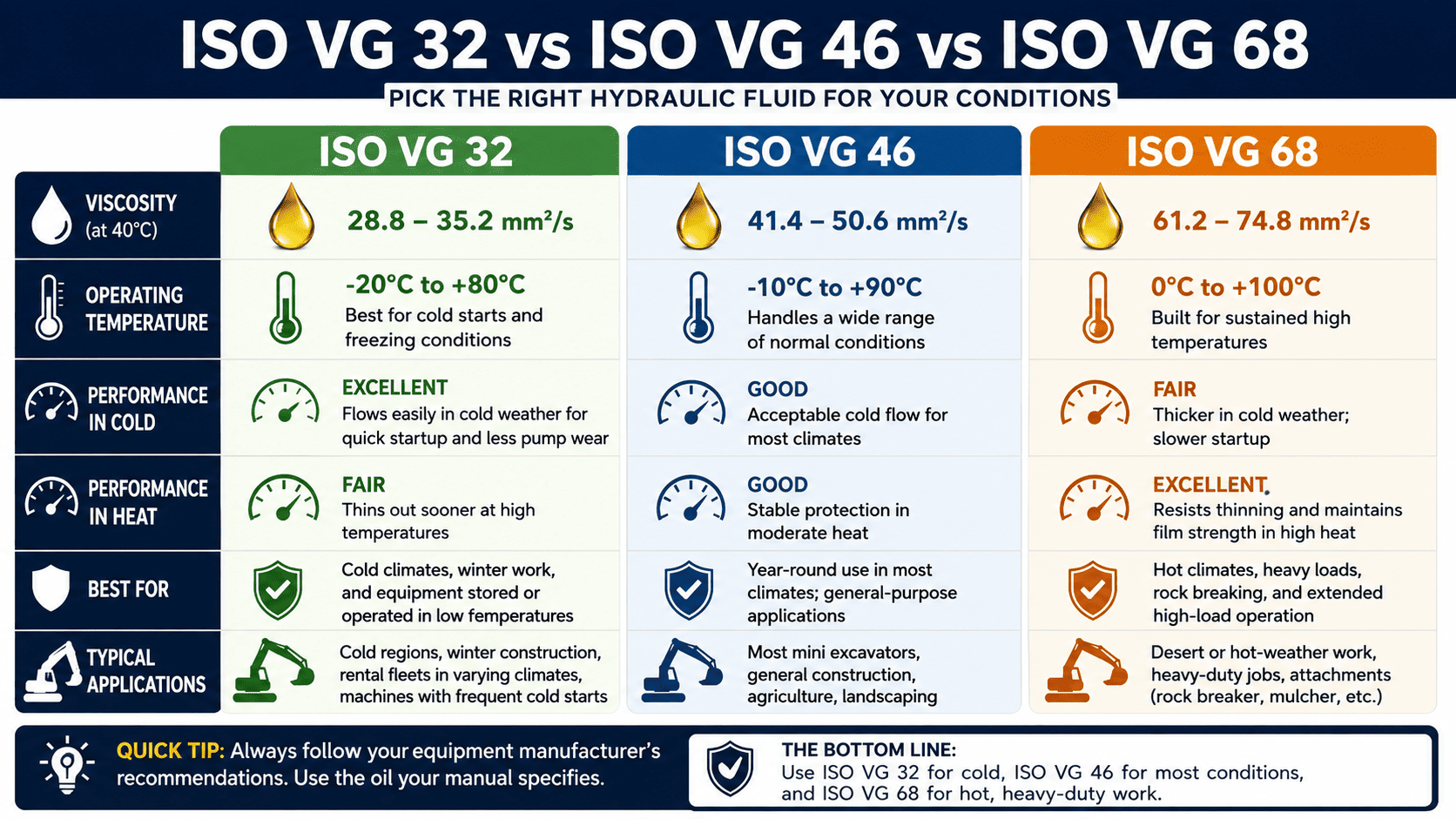
The ISO VG (Viscosity Grade) system assigns a number based on the fluid’s kinematic viscosity measured in centistokes (cSt) at 40°C. Higher number means thicker fluid.
| Viscosity Grade | Viscosity at 40°C | Best Temperature Range | Main Advantage | Typical Use |
| ISO VG 32 | ~32 cSt | -20°C to 40°C (-4°F to 104°F) | Flows freely in cold weather | Winter operations, cold climates |
| ISO VG 46 | ~46 cSt | -10°C to 50°C (14°F to 122°F) | Balanced year-round performance | Standard mini excavator work |
| ISO VG 68 | ~68 cSt | 0°C to 60°C (32°F to 140°F) | Better film strength in heat | Hot climates, heavy-duty applications |
Most OEMs land on ISO VG 46 as their default recommendation because it works reliably across the temperature range most machines encounter in normal three-season operation. It’s not perfect for every condition, but it’s the best all-around choice when you’re not in temperature extremes.
ISO VG 32 vs ISO VG 46 vs ISO VG 68
Picking the right grade isn’t complicated once you know what your machine is going to face out there. Here’s a plain-language breakdown.
ISO VG 32 — What Cold-Climate Operators Need
When temperatures regularly drop below freezing, thinner fluid is the better choice. ISO VG 32 flows freely even when it’s cold, which is critical during startup. Here’s why that matters: when a hydraulic pump starts spinning, it needs oil immediately. If the fluid is too thick to flow into the pump fast enough, the pump briefly runs dry or pulls in air—a condition called “cavitation”—and that’s genuinely damaging to pump internals.
If you’re working on job sites where morning temperatures regularly sit below -10°C (14°F), ISO VG 32 is worth switching to. The trade-off is that lighter-grade oil provides thinner protection at higher temperatures, so it’s not what you want for summer heavy lifting.
ISO VG 46 — The Everyday Standard
This is the grade most contractors should default to, and for good reason. ISO VG 46 handles the full swing of temperatures you’d see across a normal working year in most parts of North America, Europe, and Australia. It protects the pump, maintains proper seal lubrication, and stays stable across moderate heat. It’s also readily available from every major lubricant supplier, which matters when you need it quickly.
If your operator manual says AW 46, this oil is exactly what that means. Don’t overthink it.
ISO VG 68 — Built for Heat and Punishment
Running a machine in summer heat in the desert, doing extended rock-breaking work, or operating through long high-load cycles? ISO VG 68 has the viscosity to stay thick enough to protect components even as oil temperatures climb. A lighter fluid thins out as it heats up, eventually getting too thin to maintain adequate film strength. ISO VG 68 resists that thinning effect longer.
The downside is that it moves sluggishly when cold. Startup on a cool morning with ISO VG 68 in the system can feel stiff, and the pump is doing more work in those first few minutes. It’s a trade-off worth making if sustained heat is your bigger problem.
Why Using the Correct Mini Excavator Hydraulic Fluid Matters
This isn’t a “follow the rules for the sake of it” situation. The consequences of running the wrong fluid are real, measurable, and expensive.
Pump wear happens fast with wrong viscosity. Hydraulic pump internals operate with tolerances in the micron range. The oil film that keeps metal from contacting metal is thinner than a human hair. If that film breaks down because the fluid is wrong — wrong viscosity, wrong additive package, wrong chemistry — metal-on-metal contact starts immediately. It’s progressive damage. The pump doesn’t fail overnight, but it’s dying a little with every hour.
Anti-wear additives actually do the heavy lifting. AW-rated hydraulic fluids contain zinc dialkyl dithiophosphate (ZDDP) or similar compounds that create a sacrificial coating on metal surfaces when under high pressure. Without these additives, high-load moments—hitting hard material, lifting at capacity — put unprotected metal under enormous stress.
Wrong fluid destroys seals. Hydraulic seals are engineered to be chemically compatible with specific fluid types. Run an incompatible fluid and those seals swell, harden, or shrink. The result is leaking cylinders, dripping fittings, and pressure loss across the whole system. Replacing seals throughout a hydraulic system isn’t cheap, and it’s entirely avoidable.
Viscosity mismatch wastes fuel. A pump struggling to push thick oil through a cold system is burning more fuel than it should. So is a pump that’s letting fluid bypass internally because it’s too thin to maintain proper sealing. Correct viscosity means the system runs at its designed efficiency point.
Component lifespan is the bottom line. A hydraulic system that gets the right fluid on the right schedule can genuinely outlast the rest of the machine. One that doesn’t? You’re looking at pump rebuilds, cylinder replacements, and valve work long before the hours on the clock suggest you should be.
Signs Your Hydraulic Fluid Needs Replacement
Your machine usually gives you warning before things get serious. Here’s what to watch for.
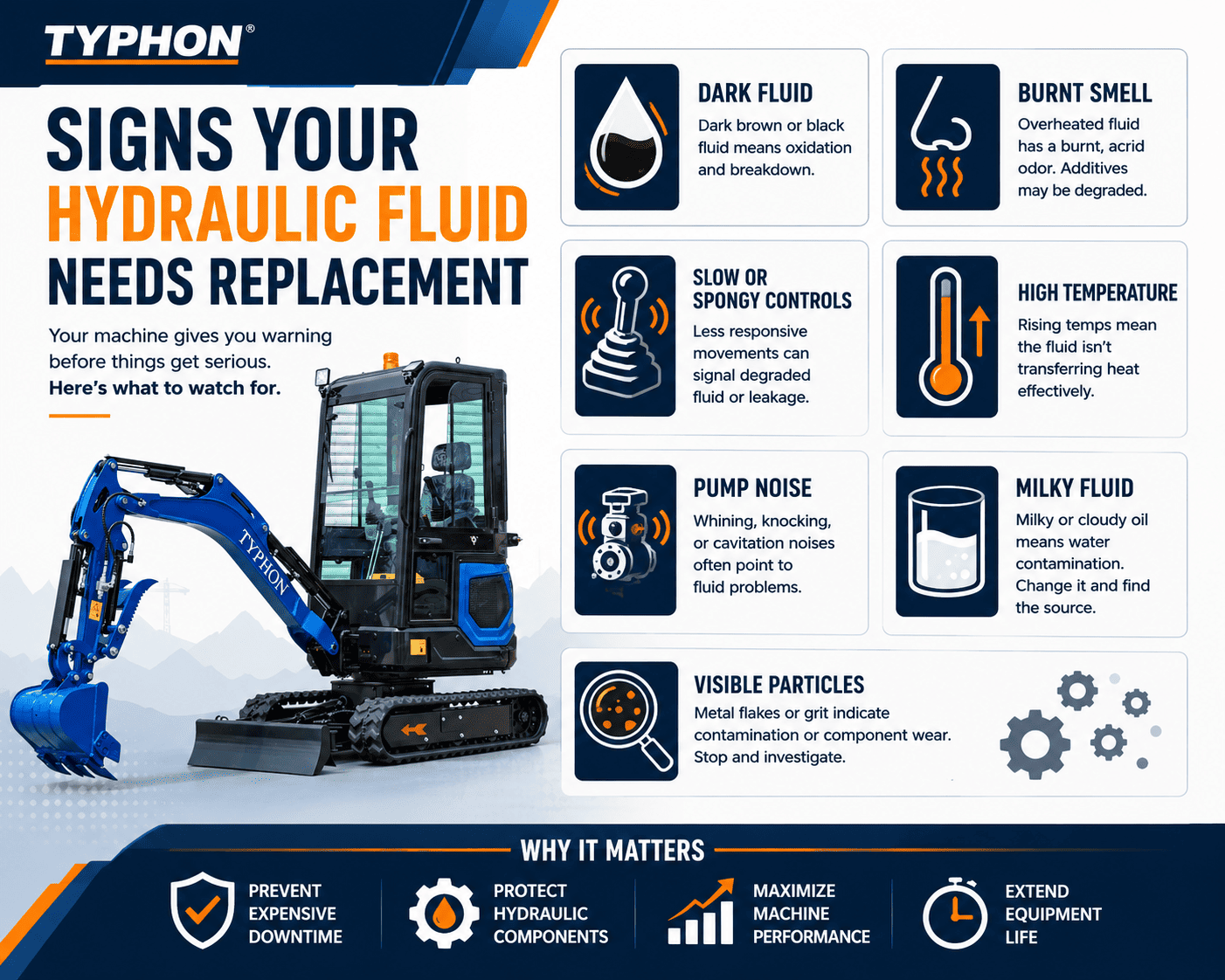
The fluid has gone dark. Fresh hydraulic oil is pale amber, sometimes nearly clear. When it starts looking brown or black, that’s oxidation — the oil has been breaking down thermally and accumulating byproducts. When it resembles used motor oil, it should have been replaced long ago.
There’s a burnt smell coming from the reservoir. Overheated fluid develops a distinct acrid smell. If you pull the dipstick and it smells like something scorched, the additive package has likely degraded significantly. That fluid isn’t protecting much anymore.
Controls feel slow or spongy. When boom and arm movements feel less crisp than they used to, deteriorated fluid or internal leakage is a common culprit. It could also signal a component problem, but degraded oil is often where the diagnostic trail starts.
The temperature gauge keeps climbing. Hydraulic fluid transfers heat. When it loses that capacity — either because it’s broken down or contaminated — the system runs hotter than it should. Repeated overheating events accelerate further degradation in a feedback loop that’s hard to break without changing the fluid.
The pump is making noise it shouldn’t. Whining, knocking, or a cavitation sound like gravel in a blender during startup—all of these point to fluid problems. Usually it’s either too thick for cold conditions, aerated from a foaming issue, or so degraded it’s not lubricating properly.
The fluid looks milky. This one’s urgent. Milky or cloudy hydraulic oil means water has entered the system—through a leaking cooler, condensation, or a contaminated fill. Water in a hydraulic system causes corrosion, promotes microbial growth in warm conditions, and degrades every surface it touches. Change the fluid immediately and find the entry point.
You can see particles in it. Metal flakes, grit, or anything that makes the fluid look cloudy or gritty means either the filter has failed or a component is breaking down. This is a stop-and-investigate situation, not a change-it-and-keep-going one.
How Often Should Hydraulic Fluid Be Changed?
There isn’t one answer that fits every situation, but here are the baselines most manufacturers and field technicians work from.
New machines get an early change. Most OEMs call for a first hydraulic fluid and filter change somewhere between 500 and 1,000 hours. The reason is break-in: new internal components shed fine metal particles as they seat, and you want that contamination out before it starts circulating permanently.
Standard mineral AW oil: After that initial change, you’re typically looking at every 1,000 to 2,000 hours under normal operating conditions or once a year—whichever milestone arrives first. Some operators on lighter-duty applications push toward the longer end of that range. Machines working hard in dusty or hot environments should be on the shorter end.
Rental fleets and heavy-use equipment: If the machine runs multiple shifts, works continuously in aggressive conditions, or sees a lot of different operators, a conservative approach — 500 to 1,000 hours — makes more sense. The cost of fluid is trivial compared to unexpected component failures.
Synthetic fluids: Premium synthetics can legitimately extend drain intervals to 3,000 hours or beyond, but you should be running oil analysis to verify the fluid is still in spec before extending. Don’t take the marketing claim at face value without actual data from your machine.
One thing that shouldn’t vary: change your hydraulic filter every single time you change the fluid. Putting fresh oil through a saturated filter defeats the entire purpose. Return filters and suction strainers get changed together at every interval.
Common Hydraulic Fluid Mistakes to Avoid
These aren’t hypothetical. They happen on real job sites every week.
Mixing fluid types. Even if both products are labeled as anti-wear hydraulic oil, additives from different formulations can react badly when combined. You can end up with sludge, foam, or reduced anti-wear protection—none of which you’ll notice until the damage is done. If you need to switch products, drain the system first.
Grabbing the wrong viscosity grade. Running ISO VG 68 through a machine operating in cold morning conditions is asking for pump cavitation. Running ISO VG 32 through a machine doing sustained heavy work in summer heat is asking for premature wear. The grade matters. Match it to your actual conditions.
Leaving contamination unchecked. Hydraulic contamination is the leading cause of premature hydraulic component failure industry-wide. Particles that are invisible to the naked eye scratch precision pump surfaces and jam valve spools. Skipping filter changes, topping off from a dirty container, or leaving the reservoir cap off while you grab a part—these create contamination problems that silently destroy components over months.
Waiting until something breaks. “It’s working fine” is the most expensive philosophy in equipment maintenance. Degraded hydraulic fluid gives no obvious performance signal until the damage it’s been causing shows up as a failed pump or leaking cylinder. By that point, you’ve paid for the fluid change and the repair.
Using cheap, off-spec oil. This one stings because the savings look real in the moment. Hydraulic oils that don’t meet ISO HM or HLP standards often skimp on the anti-wear additive package, use lower-quality base stocks, or have poor viscosity stability. The price difference per gallon is nothing against the cost of a hydraulic pump rebuild.
Overfilling the reservoir. More isn’t better here. Overfilled reservoirs cause the oil to foam as the system agitates it, and aerated oil is terrible at transmitting pressure. Fill to the marked level — not past it.
Hydraulic Fluid Maintenance Best Practices
None of this is complicated. It just requires doing it consistently.
Change filters on the same schedule as the fluid. The return filter and suction strainer don’t get a separate interval — they come out when the oil comes out, every time. A plugged filter bypasses and sends unfiltered oil straight through the system.
Pull the dipstick or check the sight glass regularly. You’re looking at color, level, and whether the fluid looks normal. Milky oil, a sudden drop in level, or anything that looks off warrants investigation before the next filter change date.
Send oil samples for lab analysis. This sounds fancy, but it’s inexpensive and incredibly useful, especially on machines with significant hours. An oil analysis report tells you the viscosity, whether there are metal particles (and what type, which points to which component is wearing), water content, and remaining additive life. It’s the most accurate way to decide whether you’re changing fluid too early or too late.
Switch grades between seasons if you need to. If your winter temperatures genuinely warrant ISO VG 32 and your summer heat calls for ISO VG 46, make the switch—but drain and flush completely rather than topping one into the other.
Store fluid properly. A drum that’s been sitting outside, uncapped, collecting rainwater and dust has no business going into a hydraulic system. Hydraulic fluid should be stored sealed, indoors or covered, away from temperature swings. This is basic stuff that gets skipped more often than it should.
Use clean transfer equipment. Dedicated funnels and transfer containers that never touch anything else. Topping off a hydraulic reservoir with a container that last held gear oil introduces additive incompatibility on top of potential contamination.
Choosing Hydraulic Fluid for Different Working Conditions
Cold Weather Operations
Machines starting in temperatures below -10°C (14°F) benefit from ISO VG 32 or a multi-grade hydraulic oil with a low pour point. Beyond the fluid choice, allow a genuine warm-up period—10 to 15 minutes at idle—before putting load on the system. Moving the machine hard before the oil has reached operating temperature is hard on every hydraulic component, regardless of which grade you’re running.
Hot Climate Conditions
Sustained summer heat or tropical job sites push systems toward ISO VG 68. In these conditions, monitor the hydraulic temperature gauge and check the fluid condition more often—heat speeds up oxidation. When the machine sits during breaks, shading it reduces the thermal load on the fluid sitting in the reservoir.
Heavy Construction Sites
Rock breaking, continuous heavy lifting, and demolition work — these applications create more heat and pressure cycling than typical excavation. Consider premium mineral or synthetic AW 46 or 68 and pull fluid analysis more frequently. The harder you push a hydraulic system, the faster the fluid degrades.
Landscaping Applications
Landscaping work is comparatively gentle on hydraulic systems—moderate loads, shorter daily operating hours, and more varied movements. Standard mineral AW 46 handles this well. The bigger concern in landscaping environments is contamination from organic debris getting near fill points or the reservoir cap.
Rental Equipment Fleets
Rental machines are the Wild West of maintenance histories. Operators follow different habits, machines get returned with undiagnosed issues, and it’s genuinely difficult to know exactly what condition any given unit’s hydraulic system is in. For fleet managers, conservative change intervals — regardless of what the fluid looks like — and a regular oil analysis program give you the best chance of catching problems before they become major failures.
Expert Recommendations for Mini Excavator Owners
After spending time around compact equipment on real job sites, a few things stand out as consistently true.
Your OEM manual is the first document you should read, not the last. Manufacturers like TYPHON Machinery engineer their hydraulic systems around specific fluid parameters. The manual spells out exactly which viscosity grades, performance classifications, and sometimes specific fluid types are required. Deviating from those specs — even with a high-quality fluid that seems similar on paper — can void warranty coverage and reduce the reliability of a system that was designed to work a specific way.
Stick with established lubricant brands. Shell, Mobil, Chevron, Total, and similar suppliers have decades of formulation history and genuine quality control. In some markets, counterfeit or diluted lubricants are a real issue — another reason to buy from authorized distributors rather than unknown online sellers.
Motor oil is not a substitute. Ever. You’d be surprised how often this comes up. Motor oil has the wrong additive package for hydraulic systems, incompatible viscosity behavior, and will degrade your seals. It doesn’t matter what grade it is or how high-quality the brand is. Purpose-formulated hydraulic fluid only.
Build a relationship with your dealer. Whether you’re running TYPHON equipment, Kubota, Bobcat, or anything else, your authorized dealer service department has the OEM documentation and practical experience to confirm the right fluid for your specific machine and your specific working conditions. It’s a phone call that costs nothing and can save you from an expensive mistake.
Keep written maintenance records. Every fluid change, every filter, every oil analysis is logged with date and hours. This is genuinely useful when something goes wrong, because you can trace back exactly when maintenance was done. It also protects you commercially: documented maintenance history supports resale value and helps in warranty discussions.
Key Takeaways
- ISO VG 46 anti-wear hydraulic oil is the most widely specified grade for mini excavators running in standard conditions.
- ISO VG 32 suits cold climates; ISO VG 68 suits hot or sustained heavy-duty applications.
- Match your fluid specification to what your OEM manual actually says — not just general guidance.
- Change mineral hydraulic fluid every 1,000–2,000 hours; always replace the filter at the same time.
- The three most damaging hydraulic maintenance mistakes are mixing fluid types, running the wrong viscosity, and ignoring contamination.
- Oil analysis is the most cost-effective maintenance tool for extending intervals and catching early component wear.
Frequently Asked Questions
What hydraulic fluid is best for mini excavators?
For most operators working in moderate conditions, a quality anti-wear hydraulic oil rated ISO VG 46 that meets ISO 6743-4 HM or DIN 51524 Part 2 HLP standards is the right call. If you’re regularly working in cold temperatures, ISO VG 32 handles cold starts better. For sustained heat or heavy-duty cycles, ISO VG 68 provides a thicker protective film. Your OEM manual will specify which grade is correct for your specific machine.
Can I use any hydraulic oil in a mini excavator?
No, and this is where people get themselves into trouble. Mini excavators need fluid that meets the performance specs in the OEM manual — the right viscosity grade and the right additive package. Generic hydraulic oils that don’t meet ISO HM or HLP standards, motor oil used as a substitute, or fluid of the wrong viscosity can all damage seals, accelerate pump wear, and cause system failures that are expensive to put right.
What is the difference between ISO VG 32, 46, and 68?
The number is the viscosity—how thick the fluid is at 40°C. ISO VG 32 is the thinnest of the three and flows easily in cold conditions, making it good for cold-climate startups but less protective at high temperatures. ISO VG 46 sits in the middle and handles a wide temperature range well, which is why it’s the standard recommendation for most mini excavators. ISO VG 68 is the thickest and provides better protection when temperatures climb but moves sluggishly when cold.
How often should mini excavator hydraulic fluid be changed?
Most manufacturers recommend an initial change between 500 and 1,000 hours on new machines, then every 1,000 to 2,000 hours for standard mineral oil under normal operating conditions. Machines working in heavy-duty or hot environments should be on the shorter end. Premium synthetics can stretch intervals further with regular oil analysis. Annual changes are a reasonable baseline for machines that don’t always hit the hour thresholds.
Can hydraulic fluid expire?
It can, especially when stored poorly. Additives can separate over time, moisture can infiltrate sealed containers, and base oil oxidation can begin even before the drum is opened. Properly sealed and stored hydraulic fluid generally stays usable for two to five years, but always inspect it before using fluid that’s been sitting for a while. If it looks hazy, smells off, or has any sediment, don’t risk it.
Can I mix different hydraulic oils?
This is one to avoid. Two fluids of the same viscosity grade from different manufacturers can have additive packages that react badly when blended—causing sludge, foam, or reduced anti-wear performance. If you need to switch brands or fluid types, drain and flush the system first. Topping up a nearly empty reservoir with a different product seems harmless but can create problems over time.
What viscosity should I use for my mini excavator?
Start with the operator manual—that’s the specification your machine was built around. ISO VG 46 is the most common recommendation for standard conditions across most brands. If you’re working in genuine cold-weather conditions regularly, ISO VG 32 gives you better cold-start protection. For hot, heavy-duty applications, ISO VG 68 is worth considering. If you’re unsure, your equipment dealer can confirm the right grade for your specific machine and environment.
How much hydraulic fluid does a mini excavator hold?
It varies quite a bit by machine size. Small 1 to 2 ton machines might have reservoirs in the 15 to 30 liter range. Larger compact excavators in the 5 to 8 ton class typically hold 60 to 100 liters or more. Please check the specifications section of your operator manual, as that is where the exact reservoir capacity for your model is listed.
Can cold weather affect hydraulic fluid performance?
Absolutely, and it’s one of the more underappreciated ways that equipment can get damaged. Cold oil is thick oil, and thick oil doesn’t flow into the pump fast enough during startup. This can cause cavitation — the pump briefly pulling in air rather than fluid — which damages internal pump components rapidly. Running ISO VG 32 in cold conditions and giving the machine a proper idle warm-up period before loading it significantly reduces this risk.
What happens if hydraulic fluid gets contaminated?
Contaminated hydraulic fluid is behind a significant portion of premature hydraulic failures. Solid particles as small as 10 to 15 microns—invisible to the naked eye—score pump surfaces and damage valve spools. Water contamination causes rust, promotes bacterial growth in warm conditions, and strips away the lubricating properties of the fluid. If you suspect contamination, drain the system, flush it, replace the filters, and find out how it happened before refilling.
Conclusion
Here’s the thing about mini excavator hydraulic fluid—it’s one of those topics that seems like routine maintenance trivia right up until it isn’t. The machine that’s been running perfectly for 1,800 hours doesn’t give you much warning when degraded or incorrect fluid starts catching up with it. Pump replacement, cylinder seal kits, control valve work — these repairs happen, and they’re rarely cheap.
Choosing the right fluid is genuinely straightforward once you’ve read the text far. ISO VG 46 anti-wear hydraulic oil handles the vast majority of mini excavator applications. If you’re in a cold country, use ISO VG 32. In sustained summer heat with heavy work, ISO VG 68 is the right choice. Buy from a brand that actually meets the spec, change it on time, replace the filter every single time, and keep the system clean.
The contractors and fleet managers who get the most out of their equipment over the long haul aren’t doing anything exotic. They’re consistent. They follow their OEM recommendations, they don’t cut corners on fluid quality, and they stay ahead of maintenance instead of reacting to failures.
Check your manual. Use the right fluid. Change it on time. That’s really all there is to it—and it makes an enormous difference over the life of a machine.