Skip to content
Quick Answer: Does a "1.5-Ton" Mini Excavator Weigh 1.5 Tons?
Key takeaways
Mini excavators marketed as 1.3-ton, 1.4-ton, 1.5-ton and 1.6-ton models often have an actual dry weight of around 1 ton (roughly 2,000–2,200 lbs) or less.
Sellers usually say the tonnage is the machine's operating weight. Operating weight includes the operator and all working fluids (fuel, hydraulic oil, coolant), which together usually add 200–400 lbs. That is not enough to turn a 1-ton machine into a 1.6-ton one.
Always verify the exact dry weight of the specific machine before you buy, plan transport, calculate towing limits or choose a trailer.
Dry Weight vs Operating Weight vs Shipping Weight
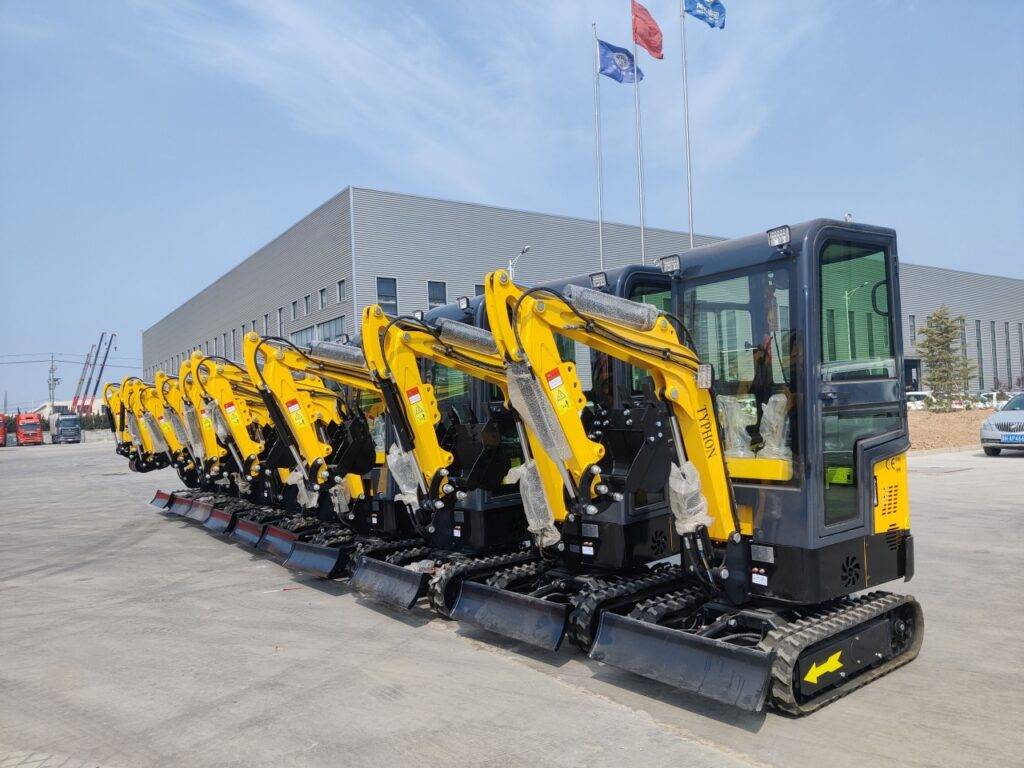
Operating weight should only be a little heavier than dry weightHow the industry is supposed to rate compact excavators
When you shop for a compact excavator, the size in the title (a "1.5-ton" machine, for example) is supposed to describe its operating weight. That's a sensible habit. Operating weight is the mass that actually sits on the ground while you dig, so it decides how stable the machine feels and how much it can lift.
The ISO 6016 standard, which sets out how earth-moving machinery is weighed, counts operating mass as the machine with its standard equipment, an operator of about 75 kg (165 lbs), a full fuel tank and every other fluid at its working level. Nothing else. No extra counterweight that isn't fitted and no rounding up. On small machines, the difference between dry and operating weight is a few hundred pounds, not half a ton.
| Weight type | Operator | Fluids | What it's for |
|---|---|---|---|
| Dry weight | No | No | Comparing how much machine you actually get |
| Operating weight | Yes, ~165–200 lbs | Full | Size class, stability, lifting and digging performance |
| Shipping weight | No | Little fuel | Trailer choice, towing limits and freight quotes |
| "Marketing" tonnage | Unclear | Unclear | Verify before trusting |
The Simple Math That Exposes Inflated Tonnage
One addition catches most inflated listingsBased on a 1,000 kg dry machine, typical of the 1-ton class
Take a machine with a dry weight of 1,000 kg. Now be generous: add the heaviest realistic operator and every fluid filled to the top. That's about 180 kg, or 400 lbs. The machine's honest operating weight lands at roughly 1,180 kg, or 1.18 metric tons. Anything above that on the listing isn't operating weight. It's weight the machine doesn't have.
- 1.2THONEST1-ton dry machine, fully fuelled with operator✓ Adds up · about 1,180 kg
- 1.3TLISTEDSold as a 1.3-ton mini excavator+119 kg / 262 lbs unexplained
- 1.4TLISTEDSold as a 1.4-ton mini excavator+219 kg / 483 lbs unexplained
- 1.5TLISTEDSold as a 1.5-ton mini excavator+319 kg / 703 lbs unexplained
- 1.6TLISTEDSold as a 1.6-ton mini excavator+419 kg / 924 lbs unexplained
| Listed size | Listed weight | Honest max (1,000 kg dry) | Unexplained gap |
|---|---|---|---|
| 1.2 ton | 1,200 kg | 1,181 kg | ≈ 0 kg · plausible |
| 1.3 ton | 1,300 kg | 1,181 kg | 119 kg / 262 lbs |
| 1.4 ton | 1,400 kg | 1,181 kg | 219 kg / 483 lbs |
| 1.5 ton | 1,500 kg | 1,181 kg | 319 kg / 703 lbs |
| 1.6 ton | 1,600 kg | 1,181 kg | 419 kg / 924 lbs |
Notice the 1.2-ton row. A 1-ton dry machine sold as a 1.2-ton excavator can be perfectly honest, because operating weight really does push it into that range. The problem starts at 1.3 tons and becomes impossible to defend at 1.5 and 1.6.
How an Inflated Weight Rating Costs You on the Job
The number on the listing isn't just marketing. You plan your work, your trailer and your budget around it. When it's stretched, every decision built on it is off too.
For transport, always plan from the real shipping weight. You can see how we handle it on our mini excavator delivery page, and machine data is in the TYPHON operator manuals. When you size tools, use guides like our attachments for mini excavators under 2 tons, and if you want to run the full numbers on value, our mini excavator cost and ROI analysis walks through it.
How to Spot an Inflated Mini Excavator Listing
Honest listings and inflated ones look very different once you know where to look.
5 Steps to Verify a Mini Excavator's Real Weight
Get both numbers, in kg or lbs, for the exact model and configuration you're buying: cab or canopy, standard bucket, thumb or no thumb.
Operator, full fuel, hydraulic oil, coolant, bucket. If the seller can't break it down, treat the number as marketing, not a spec.
Dry weight plus 200–400 lbs should land close to the advertised operating weight. Use the checker below.
Line machines up by dry weight, dig depth and bucket width. Ignore the tonnage in the title until it's proven.
A weighbridge slip or the freight weight on the bill of lading is the hardest number to argue with.
Check a listing yourselfEnter the size from the listing and the dry weight from the spec sheet
Why TYPHON's Lineup Jumps From 1.1 Tons to 1.7 Tons
You won't find a 1.3, 1.4 or 1.5-ton TYPHON. We could add three more size classes tomorrow by printing bigger numbers on the same small machine. We'd rather not. TYPHON's compact range goes from honest 1 to 1.1-ton excavators straight to machines in the 1.7 to 1.8-ton class, because a real step up in size should mean a real step up in weight, reach and stability.
| Model | Class | Key features |
|---|---|---|
| TYPHON TERROR ONE STORM | 1 ton | Canopy, hydraulic thumb clip, hydraulic oil cooler, 13.5hp B&S engine |
| TYPHON TERROR X STORM | 1 ton | Canopy, hydraulic thumb clip, hydraulic oil cooler |
| TYPHON TERROR ONE | 1.1 ton | Cabin, hydraulic thumb clip, hydraulic oil cooler, 13.5hp B&S engine |
| TYPHON TERROR XI STORM | 1.1 ton | Boom swing, hydraulic thumb clip, canopy, 400mm bucket |
| — | 1.3–1.5 ton | Not offered, by design |
| TYPHON 18 FLEX PRO | 1.8 ton | Kubota D722 engine, 12 attachments |
| TYPHON TERROR XVIII | 4,000 lbs | Kubota D902 diesel engine |
Not sure which size fits your work? Our honest 2026 mini excavator buyer's comparison covers sizing by job type, and you can browse every model on the TYPHON mini excavators page.
Watching a machine dig is one of the easiest ways to judge its real size. TYPHON machines are also listed on the official TYPHON brand store on Walmart and you can find TYPHON mini excavators on Amazon. Whichever store you use, the same rule applies: ask for the dry weight.
Mini Excavator Weight: Common Questions
Often it doesn't. Operating weight is meant to be slightly higher than dry weight because it includes the operator and fluids, but that difference is usually only 200–400 lbs. If a machine weighs about 1 ton dry, its true operating weight is roughly 1.1–1.2 tons, not 1.5. Check the dry or shipping weight on the spec sheet.
Dry weight is the bare machine with no operator and no working fluids. Operating weight adds an operator, a full fuel tank, hydraulic oil and coolant. Operating weight tells you how the machine behaves on site; dry weight tells you how much machine you're actually buying.
On a 1-ton class mini excavator, the operator and all fluids usually add about 200–400 lbs (90–180 kg) in total. The ISO 6016 weighing standard counts the operator as about 75 kg (165 lbs). More on fluids in our guide to hydraulic fluid for mini excavators.
Not necessarily. A 1-ton dry machine plus an operator and fluids can honestly weigh about 1.1–1.2 tons, so a 1.2-ton operating weight can be accurate. The labels that don't add up are 1.3 tons and above on machines that weigh about 1 ton dry.
It depends on the seller. A US short ton is 2,000 lbs and a metric ton is 1,000 kg, or about 2,205 lbs. Ask which one the listing uses. Either way, a 1-ton dry machine can't honestly be rated at 1.4–1.6 tons.
Ask for dry and shipping weight in writing, ask what operating weight includes, compare machines by dry weight and working specs, and request a scale ticket or freight weight where possible.
TYPHON names its machines by their real size class. The compact range goes from 1 to 1.1-ton models straight to 1.7 and 1.8-ton machines, so every step up in tonnage is a real step up in machine.
Buy the Weight You Pay For
Ask our team for the dry, shipping and operating weight of any TYPHON machine. We'll put it in writing and help you choose the right size for the job.
Shop Mini Excavators Talk to Our Team