Skip to content
Uses of Mini Excavators: Everything You Need to Know Before Your Next Project
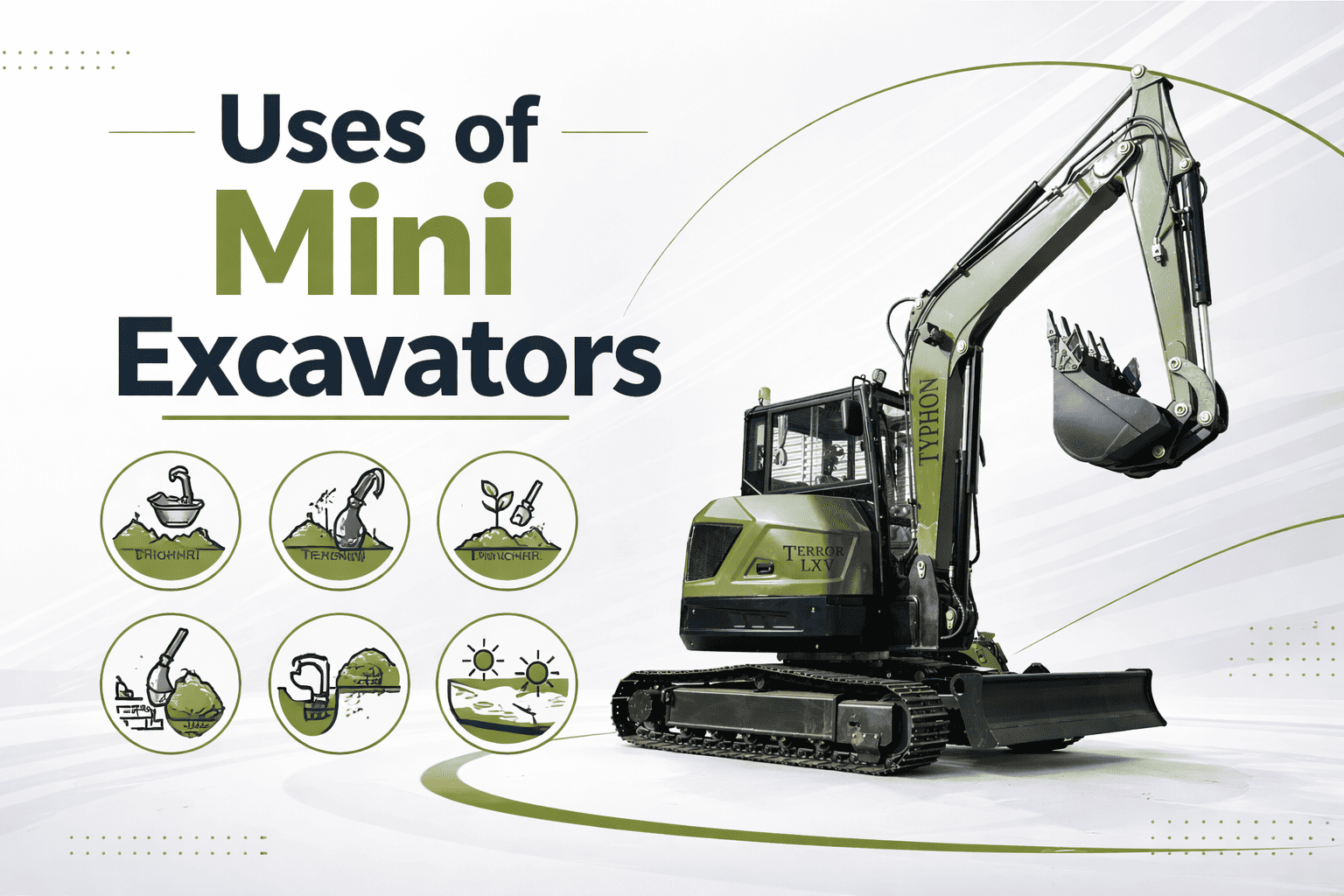
Mini excavators are highly versatile, compact construction machines primarily used for tasks where space is limited. Their top five uses include landscaping and hardscaping (planting trees, building retaining walls), small-scale demolition (tearing down sheds or driveways), trenching and digging (laying utility lines or pipes), material handling (moving dirt, gravel, and debris), and precision grading (leveling ground for foundations).
There’s something almost surprising about watching a mini excavator work for the first time. It looks compact—almost toy-like compared to the iron giants you see on highway construction sites—but give it ten minutes on a job, and you quickly realize this machine means serious business.
Mini excavators, sometimes called compact excavators or mini diggers, have exploded in popularity over the last two decades. Rental yards can’t keep them on the lot. Contractors who once relied on manual crews for small-scale digging now call the rental company first. Homeowners tackling landscaping overhauls are hiring them by the day. And it’s not difficult to see why.
These machines weigh anywhere from under a ton to around eight or nine metric tons, depending on the model. They run on rubber tracks that won’t chew up your lawn or scratch your driveway. They can squeeze through a garden gate, turn around in a corridor, and still move enough earth in an afternoon to make your jaw drop. When paired with the appropriate attachment, they seamlessly transition from a digger to a demolition tool to a material handler.
However, many people fail to fully comprehend the wide range of tasks that a mini excavator can perform. This guide breaks that down in real detail. Whether you’re a contractor deciding if a compact machine is right for your project, a landscaper expanding your service offerings, or someone planning a major home renovation, this is the information you actually need.
1. Landscaping and Hardscaping
Let’s start with one of the most common reasons people reach for a mini excavator in the first place. Landscaping and hardscaping work is physically brutal when done by hand. Digging out a patio footprint, leveling a sloped garden, clearing an overgrown area, or installing a retaining wall—these are hours and hours of backbreaking manual labor, or they’re an afternoon’s work with a mini excavator. The difference is staggering.
The Access Problem That Mini Excavators Solve
Here’s a scenario that plays out frequently on job sites. A homeowner wants their rear garden completely redesigned. There’s a 90cm gate at the side of the house. There are fences, existing flower beds, a greenhouse, and a mature tree they definitely don’t want damaged. A standard excavator? Forget it. It is not getting in, and even if it did, the collateral damage would be costly.
A mini excavator designed for tight access—some models have retractable undercarriages that compress to under 980mm — rolls straight through that gate, spins on a zero-tail-swing chassis, and gets to work without touching anything around it. The operator has full 360-degree visibility and hydraulic controls precise enough to place a bucket within a few centimeters of a garden wall without touching it.
That precision matters enormously in landscaping. You’re often working next to things you can’t damage—existing drainage, buried irrigation lines, tree root zones, decorative borders. Mini excavators give you the freedom to work right up to those boundaries.
What Landscaping Work Actually Looks Like
Grading is probably the most universal landscaping task for mini excavators. If you’ve got a garden that doesn’t drain properly, collects standing water, or just has an awkward slope, regrading the topography fixes it. An operator can strip topsoil, reshape the subsoil, then grade back to a smooth finished level with remarkable accuracy using a combination of the digging bucket and a grading blade attachment.
Retaining wall construction is another big one. You can’t just stack blocks on flat ground and hope for the best — the foundation needs to be dug out, leveled, and often filled with compacted stone. A mini excavator performs that prep work in a fraction of the time it would take by hand, ensuring the wall sits on a proper base that will actually last.
Water features have become genuinely popular in garden design, and every pond, stream channel, or rill needs to be dug out. Hand digging a 3,000-liter pond is miserable work. A mini excavator does it in under an hour and shapes it far more cleanly. The same goes for bog gardens, swales, and decorative drainage channels.
Tree planting on a professional scale also benefits massively. Large specimen trees need large planting holes—sometimes 800 mm to 1.2 metres wide and deep. Digging those by hand is exhausting. An auger attachment on a mini excavator drills those holes in minutes, and the machine can then lift and place balled-root trees using a grab attachment.
Stump removal used to mean chemical treatment, a stump-grinder rental, or hours with a mattock and chainsaw. A mini excavator with a ripper tooth or root rake tears stumps out cleanly. It also pulls up the major roots, which a stump grinder leaves behind.
Hardscaping: Getting the Base Right
Anyone who’s had a patio sink crack or develop drainage problems after a couple of winters knows how crucial the sub-base is. The surface material is almost secondary — it’s what’s underneath that determines how long a hardscaped area lasts.
Mini excavators excel at the excavation and sub-base preparation that good hardscaping demands. Stripping topsoil to the right depth across an entire patio or driveway footprint, achieving a consistent level throughout, and then compacting sub-base layers with a vibrating plate compactor attachment — all of this is far more accurate and consistent with a machine than with human labor.
2. Small-Scale Demolition
Demolition often evokes grand, dramatic visuals. But the reality of most demolition work is controlled, calculated, and actually quite intricate. Knocking down a garden outbuilding, breaking out an old concrete driveway, removing a brick boundary wall, or stripping out old foundations — this is the bread-and-butter demolition work that happens on residential and light commercial sites every single day.
Hydraulic Breakers Change Everything
The hydraulic breaker attachment is what turns a mini excavator into a demolition machine. These attachments mount to the arm in place of the bucket and deliver powerful percussive blows—essentially a mechanized jackhammer controlled by the machine’s hydraulic system.
The performance difference compared to a handheld breaker is significant. A person operating a 20kg electric or pneumatic breaker works at a limited rate and fatigues within an hour or two. They’re also directly exposed to vibration, which has real long-term health implications (hand-arm vibration syndrome is a recognized occupational hazard). A mini excavator with a hydraulic breaker keeps the operator in the cab, protected and comfortable, while delivering sustained breaking force for hours.
A 3-tonne mini excavator running a mid-range hydraulic breaker can typically remove a 100 mm reinforced concrete slab at around 15–25 square metres per hour depending on reinforcement density. A two-person crew would take most of a day to break the same slab manually.
Selective Demolition: The Real Skill
Where mini excavators genuinely shine in demolition is selective work. Only part of the structure is being taken down. Removing a concrete floor in a building while leaving the walls standing. Demolishing a section of brick wall without disturbing the adjacent fence. These tasks require finesse, not brute force.
Mini excavators provide that finesse through responsive hydraulic controls and excellent sightlines from the cab. An experienced operator can place the breaker tip within centimeters of a keep line and work confidently. They can peel back concrete in layers to expose reinforcement, cut around service entries, or work tight to a foundation without undermining it.
Interior demolition is another area where compact machines have opened up possibilities. Some mini excavators are specifically designed for indoor use—electrically powered or with diesel particulate filters— and are narrow enough to enter buildings through standard doorways. They can strip concrete floors, break through partition walls, and remove internal structures far faster than manual methods, all in spaces too confined for conventional equipment.
Clearing Demolition Waste
Once material is broken, it still needs to go somewhere. Mini excavators handle waste clearance too. Swapping to a sorting grab or clamshell bucket lets the operator pick up broken concrete, brick rubble, or mixed waste and load it directly into a skip or dump truck. It’s efficient, it keeps the site cleaner, and it reduces the manual handling burden on the rest of the crew substantially.
3. Trenching and Digging
This is core excavator territory. Digging long, narrow, precise channels in the ground is fundamental to plumbing, drainage, electrical infrastructure, telecoms, gas, and irrigation. Mini excavators handle residential and light commercial trenching better than almost any other tool—and the reasons go beyond just speed.
Consistency Is the Real Advantage
When you dig a trench by hand, depth and width vary. A person gets tired, their technique changes, and the trench wanders. For drainage trenching that needs a consistent gradient—say, a 1-in-100 fall across 50 meters of French drain—inconsistency causes problems. Water pools where the trench dips unexpectedly or won’t flow where the gradient is too shallow.
A mini excavator with a skilled operator produces consistent, clean-sided trenches. The bucket width defines the trench width precisely. Depth is controlled by boom and arm position. Experienced operators can maintain a gradient visually using level references, and machines equipped with laser or GPS grade control systems can do it automatically with sub-centimeter accuracy.
The Range of Trenching Work
Utility trenching covers a giant spectrum. Water supply trenches for new builds typically go 750mm deep in the UK and Ireland to protect against frost—deeper in colder climates. Electrical conduits, gas mains, and telecommunications ducting each have their own depth requirements, and they often require separation from one another. A mini excavator can dig multiple parallel trenches in a day, keeping each at its required depth and separation.
Drainage work might be the most common mini excavator trenching application in residential and commercial settings. Installing soakaways, perimeter drains around buildings, surface water channels, or below-ground stormwater management systems all start with trenching. The ground conditions vary enormously—soft clay, sandy loam, compacted gravel, even soft rock — and the mini excavator handles them all with the right bucket choice.
Compact machines are also increasingly serving agricultural and horticultural trenching. Installing subsurface irrigation laterals, drainage tile systems across fields, or pond inlet and outlet pipework are all applications where miniexcavators work efficiently without leaving the kind of surface damage a larger machine would cause on soft ground.
Foundation trenching for extensions, outbuildings, and garden structures always uses mini excavators. Strip foundations need trenches that are precisely sized—too narrow and the concrete won’t meet structural requirements; too wide and you waste material. A 300mm or 450mm bucket cuts to the specified width every time.
4. Material Handling and Loading
This use of mini excavators surprises people who think of them purely as diggers. The reality is that attachment versatility transforms these machines into general-purpose site handlers—and on smaller job sites, that versatility is genuinely transformative.
How the Attachment System Works
Quick-coupler systems on modern mini excavators allow bucket and attachment swaps in under two minutes without the operator leaving the cab. You can start the morning digging a trench, swap to a hydraulic grab after lunch to move landscaping boulders, then switch to pallet forks to unload a delivery at the end of the day.
That flexibility eliminates the need for multiple machines on smaller sites. Instead of a digger plus a telehandler plus a dumper, you have one mini excavator doing all three jobs. The cost implication is significant—both in rental terms and in mobilization costs if you’re using contractors.
Practical Material Handling Tasks
Loading spoil and waste is obvious—once you’ve dug something, you need to move the material. Mini excavators efficiently load dump trucks, site dumpers, and skips. Their ability to swing through 360 degrees means they can dig and load in a single sequence without repositioning.
Moving heavy landscaping materials is where mini excavators add real value over manual approaches. A pallet of block paving weighs 700–900 kg. A ton bag of gravel is precisely what it says. Large specimen boulders for garden features can weigh several hundred kilograms. None of these can be safely moved by hand. With pallet forks or a hydraulic grab, a mini excavator handles them quickly and places them precisely.
Timber handling during groundwork and construction phases benefits from this too—moving structural timber, scaffold boards, or precast concrete units is safe, fast, and doesn’t require a large crane or telehandler.
Compaction work after trenching is another often-overlooked application. A vibrating plate compactor attachment fitted to the excavator arm tamps backfill material layer by layer as the trench is filled—the machine that dug the trench also reinstates it, without needing a separate compaction crew working behind.
5. Precision Excavation and Grading
There’s an important distinction between just digging a hole and precision excavation. The latter requires specific depths, exact gradients, defined profiles, and consistent results across large areas. It’s demanding work—and it’s increasingly where mini excavators with modern guidance technology are proving their worth.
Machine Control Technology
The integration of GPS, laser, and tilt-sensor guidance systems into mini excavators has been one of the most significant developments in the compact plant sector over the last decade. These systems display real-time bucket position on an in-cab screen, giving the operator instant feedback on depth, gradient, and cross-fall.
More advanced 3D systems — using GPS or total-station references — allow the machine to automatically limit bucket travel so it can’t cut below the design surface. The operator focuses on production speed and positioning while the system handles precision. The result is finished earthworks that hit design tolerances on the first pass, eliminating the need for secondary hand trimming or rework.
Even without guidance systems, modern mini excavators offer impressively precise manual control. Smooth, responsive hydraulic systems and intuitive joystick controls allow experienced operators to work to tight tolerances through skill and practice alone.
Where Precision Really Matters
Swimming pool excavation is one of the clearest examples. A pool shell is an exact three-dimensional shape — flat base at the specified depth, sloped walls at defined angles, and stepped or curved features in precise positions. Getting this wrong means costly concrete remediation work later. Mini excavators, working from the pool design drawings, can achieve the required shape accurately and cleanly.
Sports surface preparation demands similar precision. A synthetic football pitch, tennis court, or athletics track needs a sub-base graded to within plus or minus 10mm across the entire area. A mini excavator with grading blade or tiltrotator attachment, ideally running a GPS guidance system, achieves this far more efficiently than any manual method.
Basement excavation and underpinning work uses precision mini excavators in some of the most demanding conditions in construction. Working incrementally beneath existing foundations, removing exact amounts of material in calculated sequences, is genuinely high-stakes work where accuracy is non-negotiable.
Environmental remediation projects also call for precise, controlled excavation. Removing contaminated soil to a defined depth, without disturbing clean material below or adjacent to the excavation zone, requires the same kind of fine-grained control. Mini excavators — particularly those with low-emission or electric powertrains for sensitive environments — handle this work well.
Archaeological excavation is a niche but fascinating application. On large commercial sites with archaeological sensitivity, mini excavators are used to strip topsoil in controlled layers, following archaeologists’ instructions, and to expose features for investigation. The precision available means significant discoveries aren’t damaged or destroyed in the process.
Choosing the Right Machine for the Job
Different applications within these categories call for different machine specifications. A compact 1.5-tonne micro-excavator is perfect for garden landscaping and indoor demolition but isn’t the right tool for digging deep utility trenches. A 5–6 tonne compact excavator handles serious demolition and deep trenching with ease but might be too large for sensitive access work.
Key specifications to consider include operating weight (determines power and footprint); digging depth (varies from around 1.5 m on micro machines to over 4 m on larger compact models); bucket breakout force (relevant for hard ground and demolition); tail swing radius (critical for confined spaces); and attachment hydraulic flow capacity (determines which powered attachments you can run effectively).
Track type matters too. Steel tracks handle rough ground and rocky sites better but damage soft or finished surfaces. Rubber tracks are gentler and quieter, making them the default choice for residential and urban work.
The Bottom Line
Mini excavators represent one of the smartest investments in the compact plant sector. Their combination of tight access capability, attachment versatility, operator comfort, and genuine production power makes them relevant across a wider range of applications than almost any other machine at this size.
From transforming a residential garden to precision-grading a commercial sports surface, from cracking out an old concrete driveway to carefully exposing archaeological remains, the mini excavator does it all. To use a mini excavator properly, you must know when to call one in, what size to specify, and what attachments to have on hand. Get those decisions right, and you will find that the machine earns back its hire cost before the end of the first day on site.