Skip to content
Why Kubota D902 Is Not Suitable for a 2.5 Ton Mini Excavator
The Kubota D902 is a highly regarded, ultra-compact 3-cylinder diesel—but it is fundamentally undersized for mini excavators in the 5,000 lb-plus class, the weight range that roughly corresponds to 2.3 to 2.5 metric tons. It’s an excellent engine for mini excavators between 1 and 1.8 tons and for equipment like zero-turn mowers where loads stay light and steady.
Drop it into a 5,000+ lb excavator chassis, though, and you’re asking a small industrial engine to do a job it wasn’t built for. The result shows up as sluggish hydraulics, stalling under load, and—often—a machine that quietly performs more like a 2-ton unit than the 2.5-ton class it’s marketed as.
This isn’t a knock on the D902 itself. It’s one of Kubota’s best small diesels for what it’s designed to do. The problem is entirely about matching engine to machine class, and buyers deserve to know when that match hasn’t been made correctly.
The Core Problem: Displacement and Torque, Not Horsepower
Excavator manufacturers, and the buyers reading their spec sheets, tend to fixate on horsepower. That’s the wrong number to lead with. In earthmoving equipment, what actually determines whether a machine can dig, climb, and lift is torque—the rotational force the engine can sustain when resistance shows up—and displacement, which largely determines how much torque an engine can produce and hold onto under load.
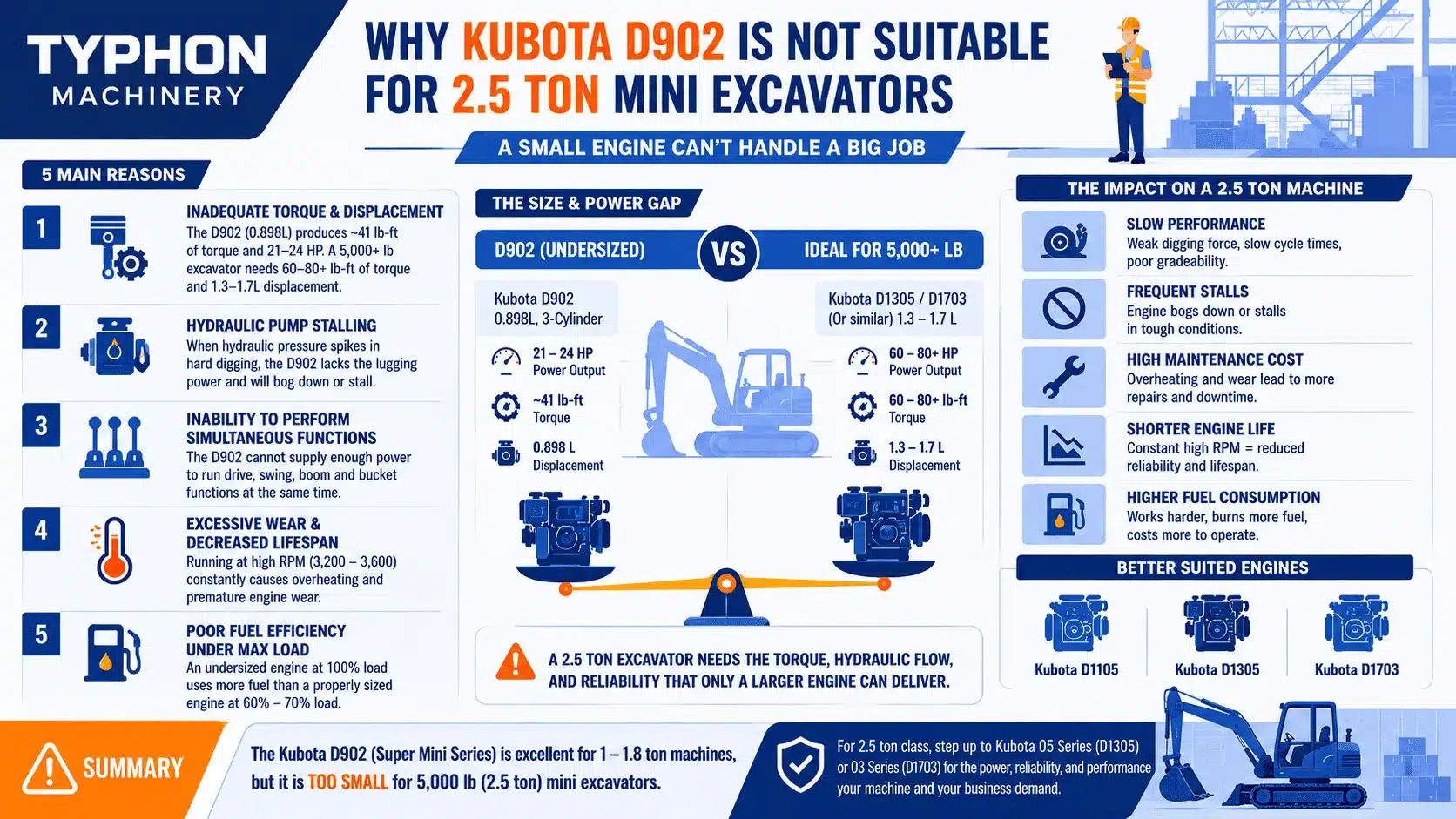
Run the numbers on the D902: it displaces 0.898 liters and produces roughly 41 lb-ft of torque alongside 21 to 24 HP. Now compare that to what a genuine 5,000+ lb excavator actually needs. Machines in that weight class are typically built around engines displacing 1.3 to 1.7 liters—the kind of displacement you find in the Kubota D1305 or D1703—producing 60 to 80-plus lb-ft of torque.
That’s not a marginal gap. It’s a torque deficit of roughly 50 to 100 percent, and torque is precisely the quality an excavator needs most: the rotational force to push through mud, climb a grade, or rip through compacted soil without losing momentum.
A machine that looks fine on a horsepower line item can still be significantly short on the one number that actually predicts digging performance.
Hydraulic Pump Stalling: Where the Problem Becomes Visible
Horsepower and torque numbers are abstract until you connect them to what the excavator is actually doing, which is running a hydraulic system. The engine doesn’t dig—it drives a pump, and the pump drives everything else: boom, stick, bucket, travel motors, and swing motor.
A 5,000 lb-class excavator needs a meaningfully larger hydraulic pump than a sub-2-ton machine simply to move its heavier boom, stick, and bucket at acceptable speeds. Here’s where the mismatch turns into a real mechanical problem: pair a D902 with the high-capacity pump a 2.5-ton chassis demands, and the engine lacks the lugging capability to back it up.
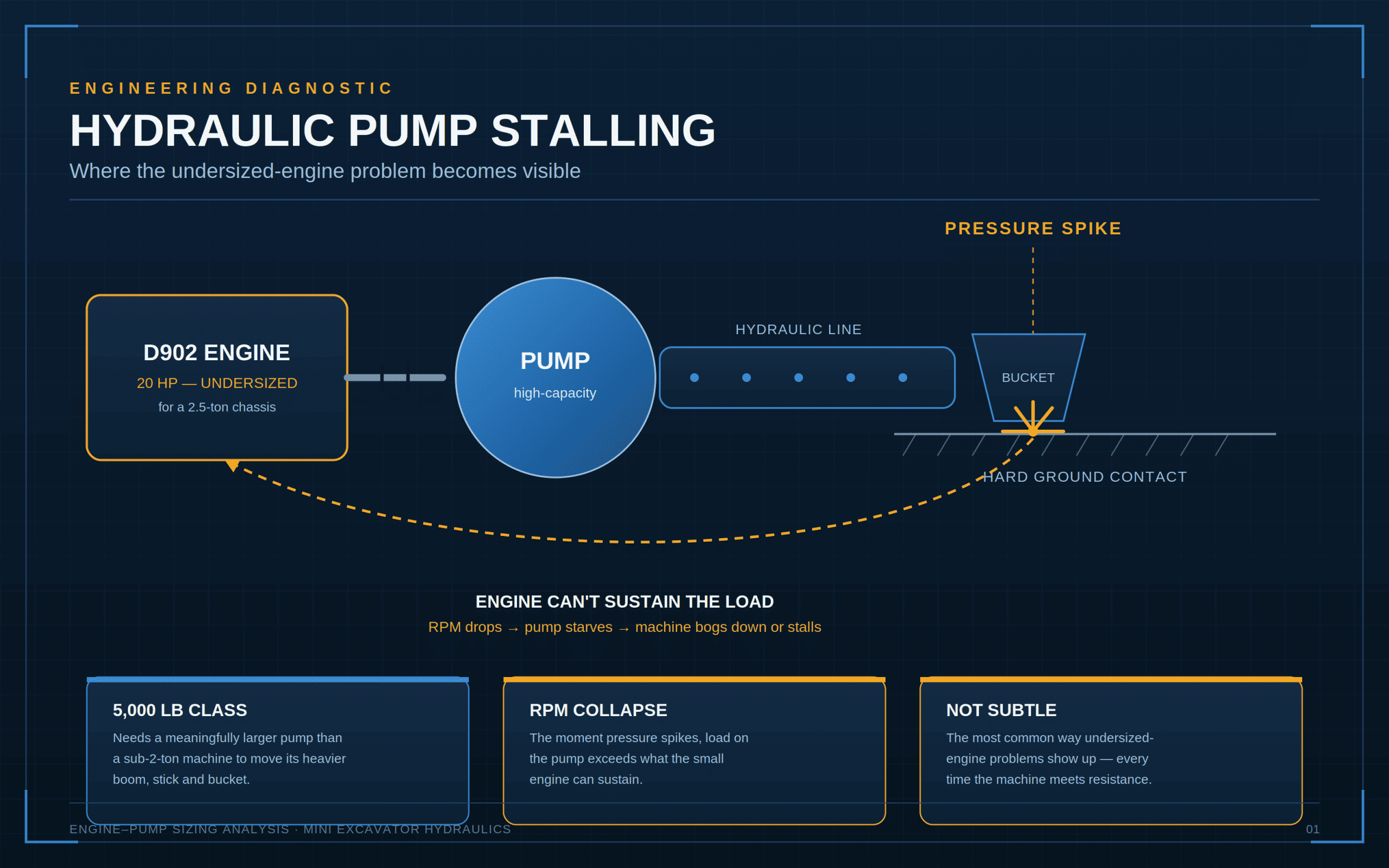
The moment the bucket hits hard ground and hydraulic pressure spikes, the load on the pump exceeds what the small engine can sustain. RPM drops, the pump can’t get the shaft power it’s asking for, and the machine bogs down—or in more severe cases, stalls outright.
This is the single most common way undersized-engine problems actually show up in the field. It’s not subtle, and it’s not intermittent—it happens every time the machine meets real resistance, which is most of the job.
Simultaneous Functions Fall Apart First
One of the clearest signs of a well-matched excavator is its ability to run multiple hydraulic functions at once—lifting the boom, curling the bucket, and swinging the cab simultaneously, for example. Skilled operators do this constantly; it’s how real digging work gets done efficiently.
Running functions simultaneously means splitting available engine power across multiple hydraulic circuits at the same time. This is exactly where an undersized engine runs out of road first. The D902 does not produce enough continuous power to divide among the drive motors, swing motor, and boom cylinders of a 5,000 lb machine without each function slowing down.
In practice, that means incredibly slow, jerky, or outright stalled movement any time an operator tries to combine functions—which is most of the time, on a real job site.
Excessive Wear and a Shortened Engine Life
To extract its full 24 HP, the D902 has to spin at very high RPM—typically 3,200 to 3,600 RPM. That’s fine for an engine spending most of its life at partial load. It’s a much bigger problem when that same engine is forced to sit near redline continuously just to move a heavy chassis and satisfy a large pump’s demand.
Larger engines actually used in the 5,000 lb class, the D1305 and D1703, among them, reach their peak torque and power at a lower, more sustainable RPM, generally in the 2,200 to 2,400 RPM range. Running a small engine at sustained high RPM under maximum load creates two compounding problems:
- Overheating. The D902’s cooling jacket and oil capacity are sized for its intended duty class, not for dissipating the heat generated by continuous 100% load in a heavier machine.
- Premature component wear. Piston rings, bearings, and valves see constant, elevated stress well beyond what the engine was engineered around, which tends to shorten service life compared to a correctly matched engine running at a comfortable load.
Fuel Efficiency Suffers Too—Not Just Longevity
The D902 has a well-earned reputation for excellent fuel economy—in the light-duty applications it was designed for. That reputation doesn’t carry over once the engine is pushed to its absolute limit just to keep a heavy machine moving.
An engine working flat-out, near maximum load continuously, typically burns more fuel than a properly sized, larger engine cruising at a comfortable 60–70% load. The “small engine saves fuel” assumption only holds when the engine isn’t being asked to overextend itself—and in a 5,000 lb excavator, it is.
Is That “2.5-Ton” Machine Actually 2.5 Tons?
Here’s the question worth asking directly: if a manufacturer pairs a D902 with a 2.5-ton chassis, what usually happens isn’t that the machine performs like a proper 2.5-ton excavator with a smaller engine bolted on. More often, the entire machine gets quietly detuned to survive—smaller pump, lower relief pressure, softer digging force—until what’s left is a machine that behaves, in practice, much closer to a 2-ton unit wearing 2.5-ton branding.
That gap matters, because “2.5 ton” as a marketing label doesn’t always map cleanly to operating weight, rated digging force, or hydraulic capacity. Before trusting the class name on a spec sheet, it’s worth checking:
- Actual operating weight (not the rounded marketing figure)
- Engine model, displacement, and torque—not just horsepower
- Hydraulic pump flow and system pressure
- Bucket and arm digging force
- Whether the machine can run simultaneous functions smoothly during a demo
None of this is an accusation against any specific manufacturer’s honesty—it’s simply a reflection of how engine-to-chassis mismatches tend to get resolved: quietly, at the hydraulic tuning level, rather than loudly on the spec sheet.
D902 vs D1305 vs D1703 — Why the Gap Is So Large
| Engine | Displacement | Rated Power | Max Torque | Torque RPM | Fit for 5,000+ lb Excavators |
| D902-E4B | 0.898 L | 24.8 HP | 56.1 Nm (41.4 lb-ft) | 2,600 rpm | Undersized—built for 1–1.8 ton class |
| D1305-E4B | 1.261 L | 24.8 HP | 80.1 Nm (59.1 lb-ft) | 1,700 rpm | Appropriately matched for 2.5-ton class |
| D1703-M-DI-E4B | 1.647 L | 24.8 HP | 97.4 Nm (71.8 lb-ft) | 1,500 rpm | Strong torque reserve, heavier-duty class |
Figures reflect Kubota’s published engine specifications. Notice that all three engines can be rated near the same 24.8 HP which is exactly why relying on horsepower alone is misleading. The real difference is torque and where in the RPM range that torque arrives. The D1305 and D1703 deliver their strongest pulling power at a lower, more sustainable RPM—right where an excavator actually spends its working life under load—rather than only near redline.
How Manufacturers Get This Right
For a genuine 5,000 lb (2.5-ton) mini excavator, manufacturers building to the class properly step up to larger engine families Kubota’s 05 Series (D1105, D1305) or 03 Series (D1703)—specifically because the D902, out of Kubota’s Super Mini Series, is simply too small to handle the hydraulic demands and physical mass that weight category involves.
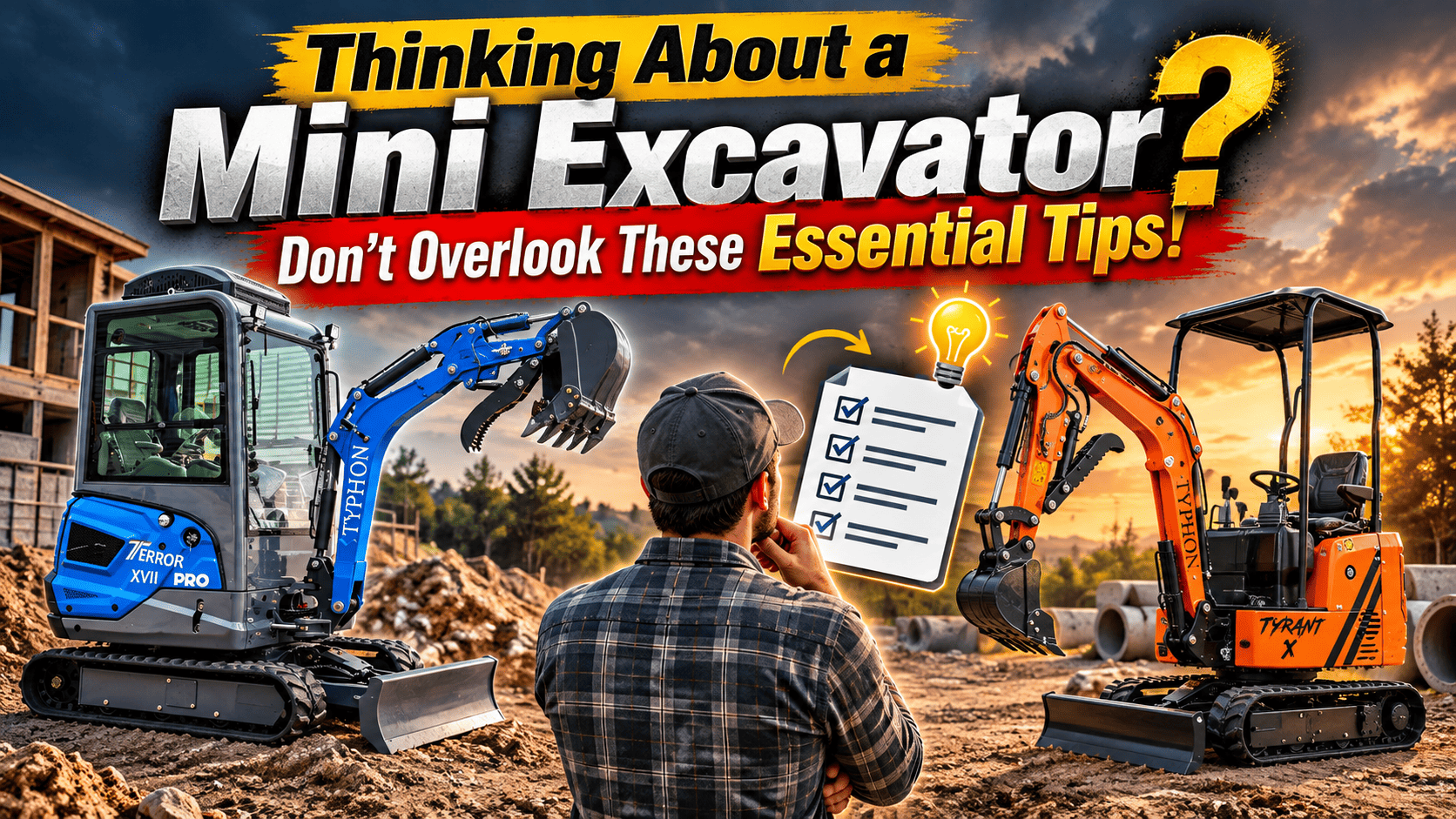
This is the same reasoning TYPHON Machinery applies across its excavator lineup, including the TERROR series of mini excavators: engine selection is matched to chassis weight and hydraulic demand first, rather than choosing the smallest, cheapest engine that clears a horsepower threshold on paper. A properly matched engine sized with enough torque reserve for the pump it’s driving is what separates a machine that performs at its advertised class from one that only looks like it does on a spec sheet. TYPHON’s US-based support and nationwide shipping also mean buyers can get straight answers on actual engine and hydraulic specifications before purchasing, rather than relying on a rounded weight class alone.
Final Verdict
The Kubota D902 isn’t a bad engine—it’s simply the wrong engine for a 5,000 lb-plus excavator. Its torque output, cooling capacity, and duty-cycle design point squarely at the 1–1.8 ton mini excavator class, not the 2.5-ton range.
When it does end up in a heavier machine, the warning signs are consistent and predictable: hydraulic bogging under load, weak simultaneous-function performance, elevated wear from sustained high-RPM operation, and fuel consumption that erases the D902’s usual efficiency advantage.
If you’re evaluating a “2.5-ton” excavator, check the engine model and torque figures before anything else—they’ll tell you more about the machine’s real capability than the weight class printed on the brochure.
FAQ’S
Why is the Kubota D902 not suitable for a 2.5-ton mini excavator? The D902 produces only about 41 lb-ft of torque from 0.898 liters of displacement, while a genuine 2.5-ton excavator typically needs 60–80+ lb-ft from a 1.3–1.7 liter engine. That torque shortfall causes hydraulic bogging, weak simultaneous-function performance, and excessive strain under real digging loads.
Could a “2.5-ton” excavator with a D902 really be under 2 tons? Often, yes, in practical terms. When a manufacturer pairs an undersized engine with a 2.5-ton chassis, the hydraulic system is typically detuned—smaller pump, lower relief pressure—to keep the engine from stalling. The result frequently performs closer to a 2-ton machine despite the 2.5-ton label.
Why does hydraulic pump stalling happen with the D902 in heavier excavators? A 2.5-ton machine needs a larger hydraulic pump to move its boom, stick, and bucket. When that pump demands more shaft power than the D902 can sustain—especially when the bucket hits resistance—engine RPM drops and the machine bogs down or stalls.
What engines are actually sized for a 5,000 lb mini excavator? Kubota’s D1305 (1.261 L, 80.1 Nm) and D1703 (1.647 L, 97.4 Nm) are the engines typically used in that class. Both deliver substantially more torque than the D902 and reach peak torque at a lower, more sustainable RPM.
Does the D902 run at high RPM constantly in a 2.5-ton excavator? To produce its rated output, the D902 needs to spin near 3,200–3,600 RPM. In a heavier machine demanding continuous power, that means sustained high-RPM operation, which increases heat and mechanical wear compared to larger engines that peak at 2,200–2,400 RPM.
Is the D902 actually more fuel-efficient in a 2.5-ton excavator? Not usually. The D902’s fuel-efficiency reputation applies to light-duty use. Pushed to its limit to move a heavy chassis, it often burns more fuel than a properly sized larger engine running comfortably at 60–70% load.
What size excavator is the Kubota D902 actually good for? The D902 performs well in mini excavators in the 1 to 1.8-ton range, along with other light-duty compact equipment like zero-turn mowers, where loads stay light and steady rather than spiking under digging resistance.
How can I check if a mini excavator’s engine is properly matched to its weight class? Compare the engine’s displacement and torque — not just horsepower — against the machine’s actual operating weight, and ask for hydraulic flow and pressure specs. If a 2.5-ton-class machine runs a sub-1-liter engine like the D902, that’s a strong signal to dig deeper before buying.