Skip to content
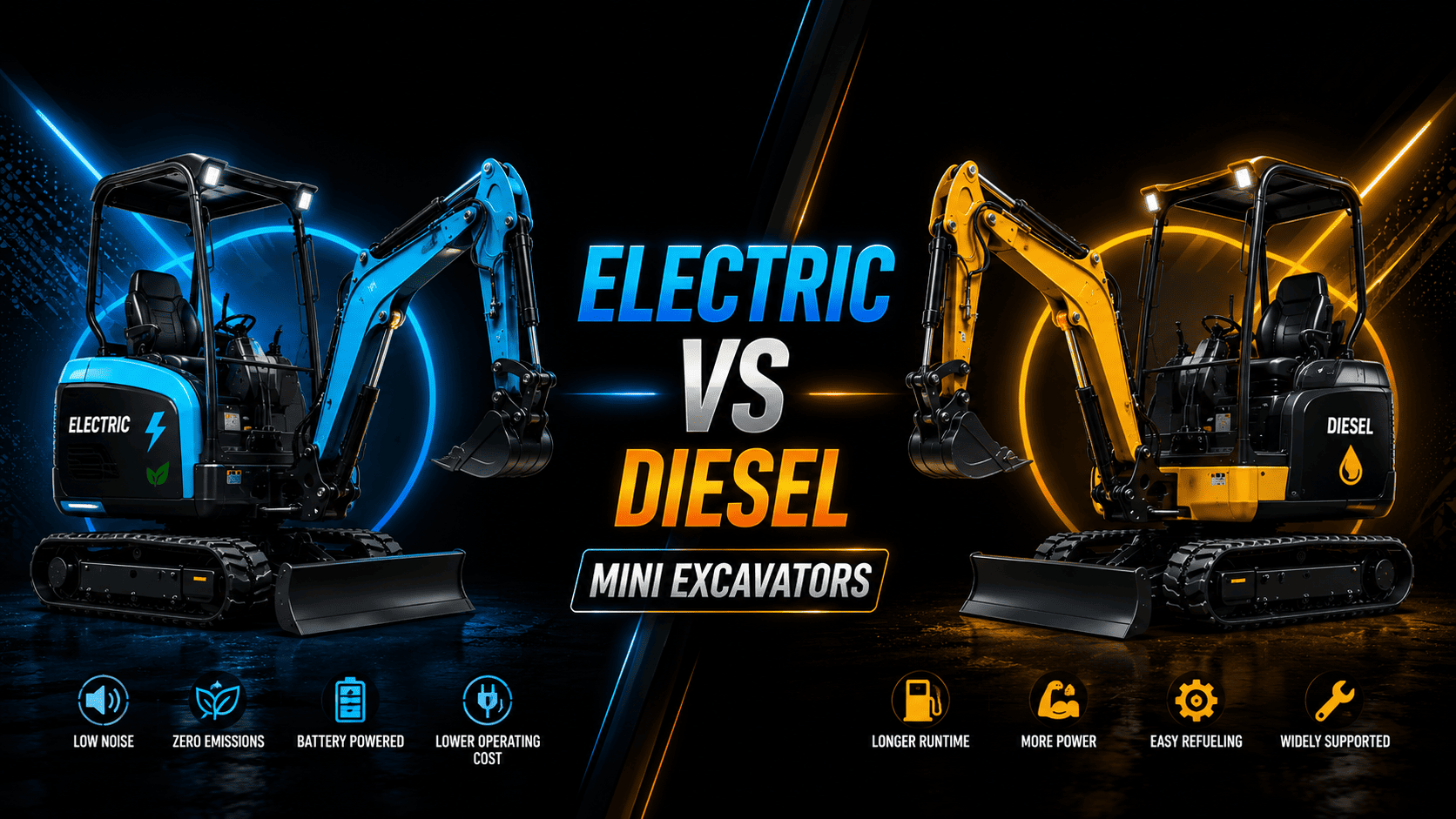
Comparison of Electric vs. Diesel Mini Excavators
If you’re weighing electric vs diesel mini excavators for an upcoming project, the honest answer is: it depends on where and how you’ll actually run the machine. Electric mini excavators can be especially attractive for indoor, residential, low-noise, and emissions-sensitive applications, while diesel mini excavators remain highly practical for longer outdoor work, remote jobsites, and situations where refueling is simply easier than recharging. Neither one wins every scenario, and any contractor who tells you otherwise is probably only working one type of job.
This guide breaks down how each powertrain works, where each one shines, what they cost to run and maintain, and how to think through the decision for your own site conditions.
Electric vs. Diesel Mini Excavators—What’s the Difference?
At the core, the difference comes down to what drives the hydraulic system. An electric mini excavator uses a battery pack and electric motor to power the hydraulics and travel motors. A diesel mini excavator uses a small diesel engine to do the same job, driving a hydraulic pump that pushes fluid through the arm, boom, bucket, and track circuits.
That single difference in power source ripples through nearly everything else about the machine:
- Noise—electric units typically run much quieter since there’s no combustion engine.
- Emissions—electric machines produce no tailpipe emissions while operating; diesel units do.
- Refueling vs. recharging—diesel means a fuel can or pump; electric means a charger and, usually, access to power.
- Maintenance—electric machines skip most engine-related service items; diesel machines still need the full engine maintenance routine.
- Operating environment—electric opens up indoor and enclosed spaces that diesel generally can’t touch without heavy ventilation.
- Runtime and jobsite flexibility—diesel still tends to offer more predictable, longer stretches of continuous work on remote sites.
None of this means one is “better” in the abstract. It means the right machine depends on the job in front of you.
Electric Mini Excavators
An electric mini excavator replaces the diesel engine with a battery pack, an electric drive motor, and the same style of hydraulic system found on a conventional excavator—pump, valves, cylinders, and hoses. Charging is handled either through an onboard charger plugged into standard power or, in some cases, a fast-charging dock, depending on the manufacturer and model. Battery management systems monitor charge state, temperature, and cell health, and the operating controls are generally laid out the same way an operator would expect from a diesel machine, so the learning curve is minimal.
Advantages
- Noticeably lower noise levels, which matters on residential streets, near hospitals, or during early-morning work windows
- No tailpipe emissions during operation, which makes them a strong fit for indoor and enclosed-space work when ventilation is limited
- Well suited to residential and urban jobs where neighbors and noise ordinances are a factor
- Fewer engine-related maintenance items—no oil changes, no fuel filters, no exhaust system to service
- Potentially lower operating costs depending on local electricity rates, how the machine is used, and how efficiently it’s charged
Limitations
- You need reliable access to charging, and charging takes time that refueling doesn’t
- Runtime is tied to battery capacity and how hard the machine is worked—heavy digging drains a battery faster than light grading
- Battery replacement is a real cost consideration over the life of the machine, even if it’s years down the road
- Charging infrastructure on a remote or temporary site can be a genuine obstacle
- Weight and model availability still vary quite a bit across manufacturers, so not every size class has a mature electric option yet
Diesel Mini Excavators
A diesel mini excavator runs on a small diesel engine that drives the hydraulic pump, which in turn powers the boom, arm, bucket, swing, and travel systems. Supporting that engine is a fuel system, a cooling system to manage engine temperature, and an exhaust system to handle combustion byproducts. This is the layout most operators have run for decades, and it’s still the default across most of the compact excavator market.
Advantages
- Refueling takes minutes with a diesel can or pump, versus a longer charging cycle
- Long, uninterrupted operating periods without worrying about remaining charges
- A mature, widespread service and parts network, since diesel compact equipment has been the industry standard for a long time
- Strong performance on outdoor jobs of nearly any duration
- Broad model selection across sizes, brands, and price points
- Practical for remote jobsites where power access is limited or nonexistent
Limitations
- Regular engine maintenance—oil, filters, coolant—adds up over the ownership period
- Higher operating noise, which can be a real problem on noise-sensitive or residential sites
- Tailpipe emissions rule out most indoor or enclosed applications without significant ventilation
- Fuel costs fluctuate with diesel prices
- Cooling and exhaust system upkeep is an ongoing maintenance category; diesel machines simply carry that electric machines don’t
For buyers comparing real-world diesel options, models like the TYPHON TERROR XIX Prestige and TYPHON TERROR XVIII Prestige illustrate the Kubota-powered diesel class buyers typically encounter in the 2–4 ton range.
Electric vs Diesel Mini Excavator: Side-by-Side Comparison
| Feature | Electric Mini Excavator | Diesel Mini Excavator |
|---|---|---|
| Power Source | Battery/electric motor | Diesel engine |
| Noise | Generally lower | Generally higher |
| Tailpipe Emissions | None during operation | Present |
| Refueling | Charging | Diesel fuel |
| Indoor Use | Excellent for suitable models | Limited by ventilation/emissions |
| Residential Work | Often attractive | Practical depending on site |
| Long Outdoor Jobs | Depends on battery/charging | Generally convenient |
| Maintenance | Different/lower engine-related needs | More engine-related service |
| Charging Infrastructure | Required | Not required |
| Fuel Infrastructure | Not required | Required |
| Remote Job Sites | Charging can be challenging. | Refueling is generally easier |
| Initial Cost | Varies by model | Varies by model |
These are general tendencies, not fixed specifications—always confirm actual figures against the manufacturer’s documentation for the specific model you’re evaluating.
Which Is Cheaper to Operate?
Operating cost isn’t just fuel or electricity—it’s the full picture: energy or fuel cost, maintenance, downtime, charging or refueling logistics, and the condition of the battery or fuel system over time, all filtered through how the machine is actually used day to day.
Electric Operating Costs
Electricity costs vary by region and by your utility rate structure, and charging efficiency and battery management both affect how much energy you actually pay for versus how much reaches the hydraulics. Maintenance costs tend to be lower on the engine side, but battery health and eventual replacement are real line items to plan for over the ownership period.
Diesel Operating Costs
Diesel fuel is the obvious recurring cost, but engine oil, filters, coolant, and the exhaust system all add to the total. None of these are optional—they’re part of keeping a diesel engine running reliably.
Be skeptical of any comparison that hands you a precise dollar-per-hour figure without qualifying it—actual costs depend heavily on local energy and fuel prices, usage intensity, and the specific model.
Electric vs Diesel Mini Excavator Maintenance
Electric Maintenance
- Battery inspection and monitoring
- Electrical connections and wiring checks
- Hydraulic fluid and filter service
- Regular greasing of pivot points
- Undercarriage and track upkeep
- Cooling system service where the model includes one
Diesel Maintenance
- Engine oil and oil filter changes
- Fuel filter replacement
- Air filter service
- Coolant checks and flushes
- Belt and hose inspection
- Exhaust component upkeep
- Hydraulic system service
- Greasing and undercarriage maintenance
Electric doesn’t mean maintenance-free—it means a different maintenance profile, with less engine-specific work but still a full hydraulic and undercarriage routine to keep up with. For a deeper look at how upkeep affects long-term value, see how maintenance cost impacts mini excavator resale.
Which Is Better for Landscaping?
Residential landscaping work—backyard excavation, drainage lines, irrigation trenches, tree removal, pool preparation, utility trenches, garden bed prep—often happens close to homes, neighbors, and normal daytime routines. That’s exactly where an electric mini excavator’s lower noise and zero tailpipe emissions tend to matter most, especially in neighborhoods with noise ordinances or early-start restrictions.
That said, diesel still makes sense for landscaping jobs that run long hours, cover larger properties, or happen in areas without practical charging access. If the crew is moving between several properties in a day with no time to plug in, diesel’s quick refueling wins out.
Which Is Better for Construction?
Foundation excavation, utility installation, trenching, and general site prep put different demands on a machine depending on daily operating hours, how accessible the jobsite is, and what performance the job actually calls for. A tight urban site with strict noise limits and available power can favor electric. A large outdoor site running ten-hour shifts with no power hookup will usually lean diesel. Machine size and required hydraulic performance matter here at least as much as the power source—don’t let the powertrain decision override the actual digging requirements of the job.
Which Is Better for Indoor Work?
This is where electric mini excavators tend to have a clear edge. Warehouses, building renovations, indoor demolition prep, industrial facilities, agricultural buildings, and other enclosed structures are all places where diesel exhaust and ventilation become serious concerns. Electric machines sidestep that problem entirely during operation.
That said, floor conditions, charging access, and the specific model’s approval for enclosed use all still need to be checked — not every electric excavator is automatically cleared for every indoor environment, and site ventilation requirements can vary by local code regardless of powertrain.
Which Is Better for Remote Jobsites?
This is diesel’s strongest ground. Quick refueling from a can or fuel truck lets a diesel machine keep working through long outdoor shifts without much planning. Electric machines require thinking ahead about charging infrastructure—whether that’s a generator, a temporary power hookup, or a charging schedule built around downtime. Portable charging solutions do exist for some machines, but they should be evaluated against the manufacturer’s approved equipment and specifications rather than assumed to work universally.
Battery Runtime vs Diesel Fuel Runtime
Electric runtime depends on battery capacity, the load being placed on the machine, hydraulic demand, ambient temperature, operator habits, which attachments are in use, how much idle time there is, and the shape of the job cycle itself. Two operators running the same machine on the same day can get meaningfully different runtimes out of it.
Diesel runtime comes down to fuel tank size, engine load, operating conditions, and fuel consumption rate—all of which also vary by how the machine is worked. Neither powertrain has a single universal runtime number, so treat any runtime claim as model-specific and verify it against the manufacturer’s published data.
Performance and Digging Power
Don’t judge digging performance by power source alone. What actually matters is hydraulic flow, hydraulic pressure, breakout force, arm force, bucket force, cycle time, operating weight, and stability. Compare the actual hydraulic and performance specifications between the specific models you’re considering rather than assuming diesel is always more powerful or electric is always weaker—the gap between models within the same powertrain can be larger than the gap between powertrains. Engine sizing relative to machine weight matters too; for example, this breakdown of why the Kubota D902 isn’t suitable for a 2.5-ton mini excavator shows how mismatched engine-to-weight ratios can undercut hydraulic performance regardless of powertrain.
Environmental and Noise Considerations
Electric machines produce no tailpipe emissions during operation and generally run quieter, which can make them a better fit for noise-sensitive environments. But it’s worth being honest that electric equipment isn’t automatically zero-impact overall — manufacturing the batteries and generating the electricity that charges them both carry their own environmental footprint. Diesel machines carry tailpipe emissions and higher engine noise but remain well established for outdoor use across nearly every job type.
Total Cost of Ownership
Total cost of ownership adds up purchase price, energy or fuel costs, maintenance, downtime, charging or fueling infrastructure, and battery considerations, then nets out resale value at the end. The machine with the lowest sticker price isn’t necessarily the one with the lowest lifetime cost—a diesel machine with heavy engine maintenance needs or an electric machine facing an eventual battery replacement can each shift the math depending on how long you plan to own it and how hard you’ll run it. Ownership length also interacts with expected service life—see this mini excavator lifespan guide for how operating hours typically translate into years of service.
Electric vs. Diesel Mini Excavator Resale Value
Resale value depends on brand, model, age, operating hours, battery or engine condition, maintenance records, market demand, dealer support, and parts availability. Electric compact equipment is still a relatively young and evolving market, so resale behavior can differ noticeably between models and regions compared to the long-established diesel resale market. There’s no guaranteed resale premium for either powertrain—it comes down to the specific machine’s condition and documented history. Maintenance records in particular play a large role in resale outcomes; see how maintenance cost impacts mini excavator resale value for more detail.
Who Should Buy an Electric Mini Excavator?
Electric may make sense if you:
- Work indoors or in enclosed spaces regularly
- Operate in residential neighborhoods with noise concerns
- Face local noise restrictions or ordinances
- Have convenient, reliable charging access
- Run predictable daily shifts
- Want to reduce tailpipe emissions on the jobsite
- Value lower engine-related maintenance over time
Who Should Buy a Diesel Mini Excavator?
Diesel may make sense if you:
- Work long shifts outdoors on a regular basis
- Move frequently between remote job sites
- Need fast, simple refueling
- Have limited or no charging infrastructure available
- Already run diesel equipment and want a consistent fleet
- Need broad, established service and parts support
Buyers in this category often start by browsing a full diesel mini excavator lineup to compare operating weight, horsepower, and engine class side by side or review the best mini excavator models for sale in the USA for a model-by-model breakdown.
Common Buying Mistakes
- Choosing electric solely because of lower emissions, without checking if it fits the actual job
- Choosing diesel solely because of longer runtime, without checking actual usage patterns
- Ignoring charging requirements before committing to an electric machine
- Ignoring real electricity costs in your area
- Ignoring fuel cost trends for diesel
- Comparing horsepower instead of actual hydraulic specifications
- Ignoring battery replacement cost down the road
- Ignoring local service and parts support
- Ignoring realistic daily operating hours
- Ignoring the specific requirements of the jobsite
- Comparing purchase price only, without factoring in total cost of ownership
How to Choose Between Electric and Diesel
Choose Electric If:
- Indoor operation is a regular part of the job
- Noise is a major concern on your sites
- Charging access is available and practical
- Your daily operating cycles are predictable
- Minimizing tailpipe emissions matters for the job or the client
Choose Diesel If:
- Long outdoor operation is the norm
- You regularly work remote sites
- Fast refueling is a priority
- Charging infrastructure is limited or unavailable
- Maximum jobsite flexibility matters more than anything else
Once you’ve settled on a powertrain, narrowing down attachments and financing options is the next step — see mini excavator attachments and mini excavator financing options for more.
Frequently Asked Questions
Which is better, electric or diesel mini excavators? Neither is universally better — it depends on the job. Electric mini excavators tend to work best for indoor, residential, and noise-sensitive applications where charging is available. Diesel mini excavators tend to work best for long outdoor shifts and remote jobsites where refueling needs to be quick and charging access is limited.
Are electric mini excavators powerful enough for construction? Many electric mini excavators offer competitive hydraulic performance for their size class, but power varies significantly by model. Rather than assuming electric is automatically less powerful, compare actual hydraulic flow, pressure, and breakout force specifications between the specific machines you’re considering.
Are electric mini excavators cheaper to operate? They can be, depending on local electricity rates, usage patterns, and maintenance needs, since they avoid most engine-related service items. However, battery replacement over the machine’s life is a real cost to factor in, so total cost of ownership should be compared rather than just day-to-day running costs.
How long can an electric mini excavator run? Runtime depends on battery capacity, load, hydraulic demand, temperature, and how the machine is used, so there’s no single universal figure. Always check the specific manufacturer’s published runtime data for the model you’re considering rather than relying on general estimates.
How long can a diesel mini excavator run? Diesel runtime depends on fuel tank size, engine load, and operating conditions, and generally allows for longer continuous operation than most electric models since refueling is fast. Actual runtime still varies by model and how hard the machine is worked.
Are electric mini excavators good for landscaping? Yes, especially for residential landscaping where noise and emissions near homes matter. Their quieter operation and lack of tailpipe emissions make them a strong fit for backyard excavation, drainage, and utility trenching in neighborhoods with noise restrictions.
Are electric mini excavators good for indoor work? Yes, electric mini excavators are often well suited to indoor and enclosed-space work because they don’t produce tailpipe emissions during operation. Ventilation, floor conditions, and the specific model’s approval for indoor use should still be confirmed before the job.
Do electric mini excavators require less maintenance? They generally require less engine-related maintenance since there’s no oil, fuel filters, or exhaust system to service. They still need regular hydraulic, battery, and undercarriage maintenance, so electric doesn’t mean maintenance-free.
Which mini excavator has better resale value? Resale value depends more on brand, model, condition, and maintenance history than on powertrain alone. Diesel has a longer-established resale market, while electric resale behavior is still developing and can vary by model and region.
Should I buy an electric or diesel mini excavator? Base the decision on your actual job requirements: operating environment, noise restrictions, charging or fueling access, typical shift length, and required performance. Electric tends to suit indoor and noise-sensitive work, while diesel tends to suit long outdoor and remote jobsite work.