Skip to content
How Does Maintenance Cost Impact Mini Excavator Resale?
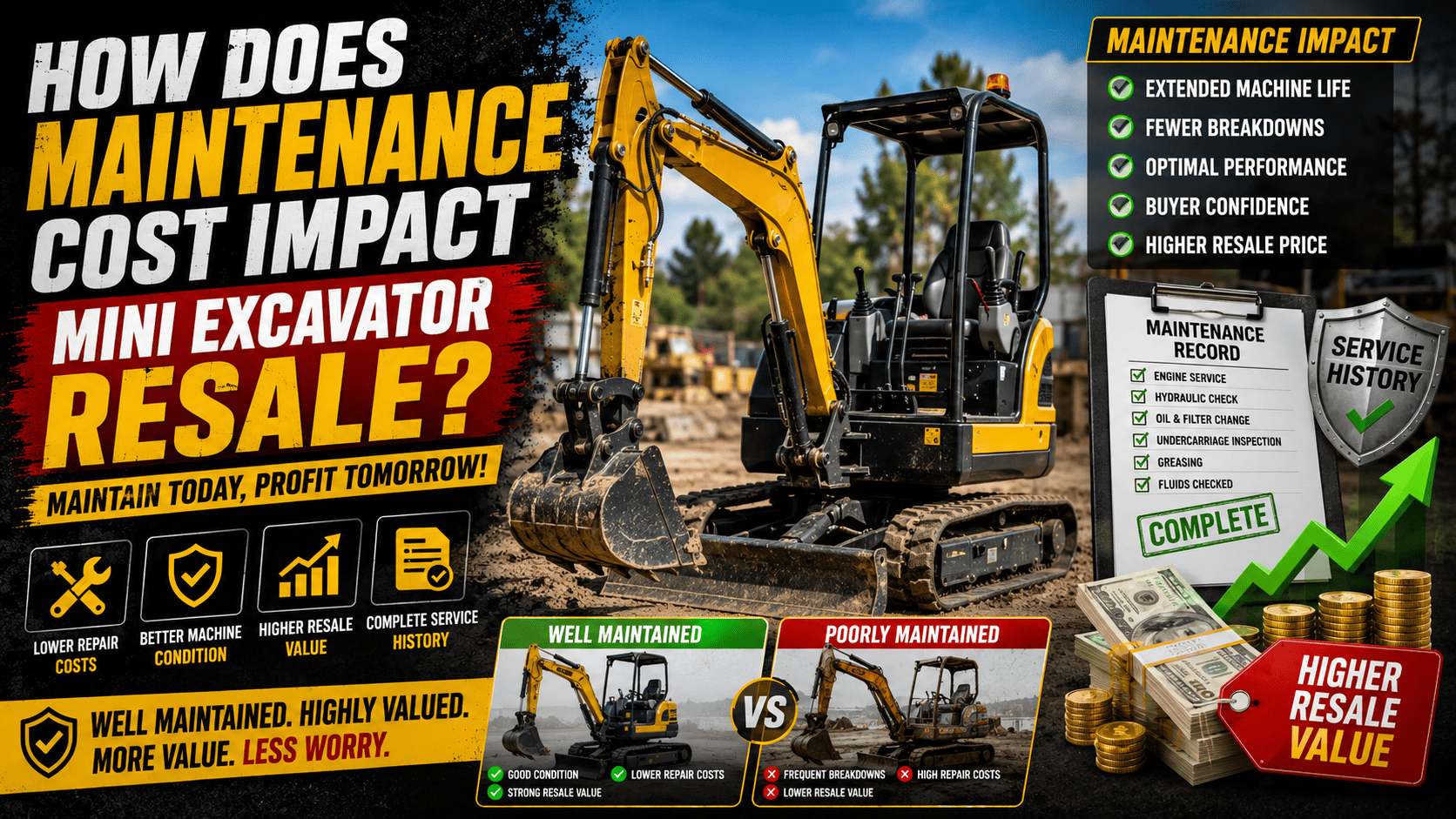
Walk any used equipment lot and you’ll notice something: dealers don’t price machines off a spreadsheet of repair receipts alone. They walk around the machine, check the undercarriage, ask for service records, and start the engine cold. That’s really the honest answer to how does maintenance cost impacts mini excavator resale—maintenance matters, but not in the direct dollar-for-dollar way many owners assume.
Yes, maintenance can have a significant indirect effect on mini excavator resale value, but buyers generally care more about the machine’s overall condition, service history, operating hours, and major component health than the maintenance bill itself. A stack of oil-change receipts doesn’t sell a machine. What those receipts represent—an engine that starts clean, hydraulics that don’t weep fluid, tracks that still have life in them—is what actually moves the price needle.
Regular maintenance won’t guarantee a higher payout when you sell. What it does is protect the condition buyers are willing to pay for in the first place. That distinction runs through this entire article, and it’s worth keeping in mind before you spend another dollar on your machine.
Does Maintenance Affect Mini Excavator Resale Value?
Yes—indirectly, through condition rather than through the invoice total.
Think of it as a chain: Maintenance → Condition → Reliability → Buyer Confidence → Resale Value. Each link depends on the one before it. Skip the maintenance link, and the whole chain weakens, even if nothing has visibly broken yet.
Spending money on your excavator doesn’t automatically add that same amount—or any fixed amount—to what you’ll get when you sell. A buyer isn’t reimbursing you for five years of oil changes.
What they’re paying for is a machine that behaves the way a well-cared-for machine behaves: predictable start-up, steady hydraulic pressure, tight pins, and tracks that aren’t stretched out. Maintenance is the mechanism that produces those traits. Resale value is the market’s reaction to seeing them.
Why Maintenance History Matters to Used Equipment Buyers
Buyers ask for service records for the same reason a home inspector checks a roof before closing—they’re trying to reduce uncertainty about what they can’t fully see.
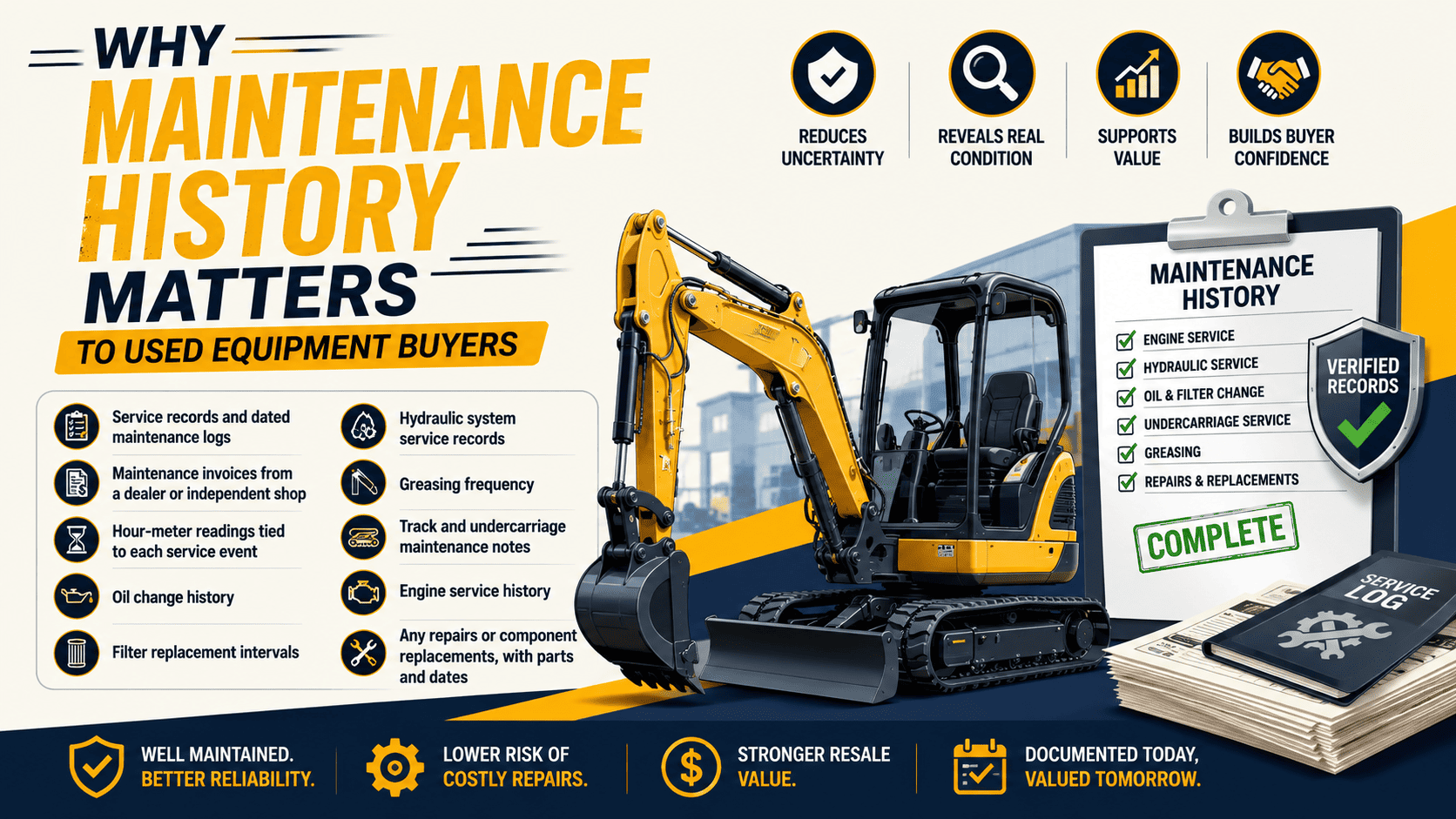
A used mini excavator hides a lot beneath its panels. You can’t tell from the yard whether the hydraulic fluid was changed on schedule or whether someone kept running the machine on dirty filters for an extra 200 hours to save money. That’s where documentation fills the gap. Buyers typically look for:
- Service records and dated maintenance logs
- Maintenance invoices from a dealer or independent shop
- Hour-meter readings tied to each service event
- Oil change history
- Filter replacement intervals
- Hydraulic system service records
- Greasing frequency
- Track and undercarriage maintenance notes
- Engine service history
- Any repairs or component replacements, with parts and dates
None of this guarantees a sale. But a buyer who sees a consistent, dated maintenance trail generally feels more comfortable making an offer close to asking price than one staring at a machine with no paperwork at all — because the paperwork answers questions the machine itself can’t.
Which Mini Excavator Maintenance Costs Matter Most for Resale?
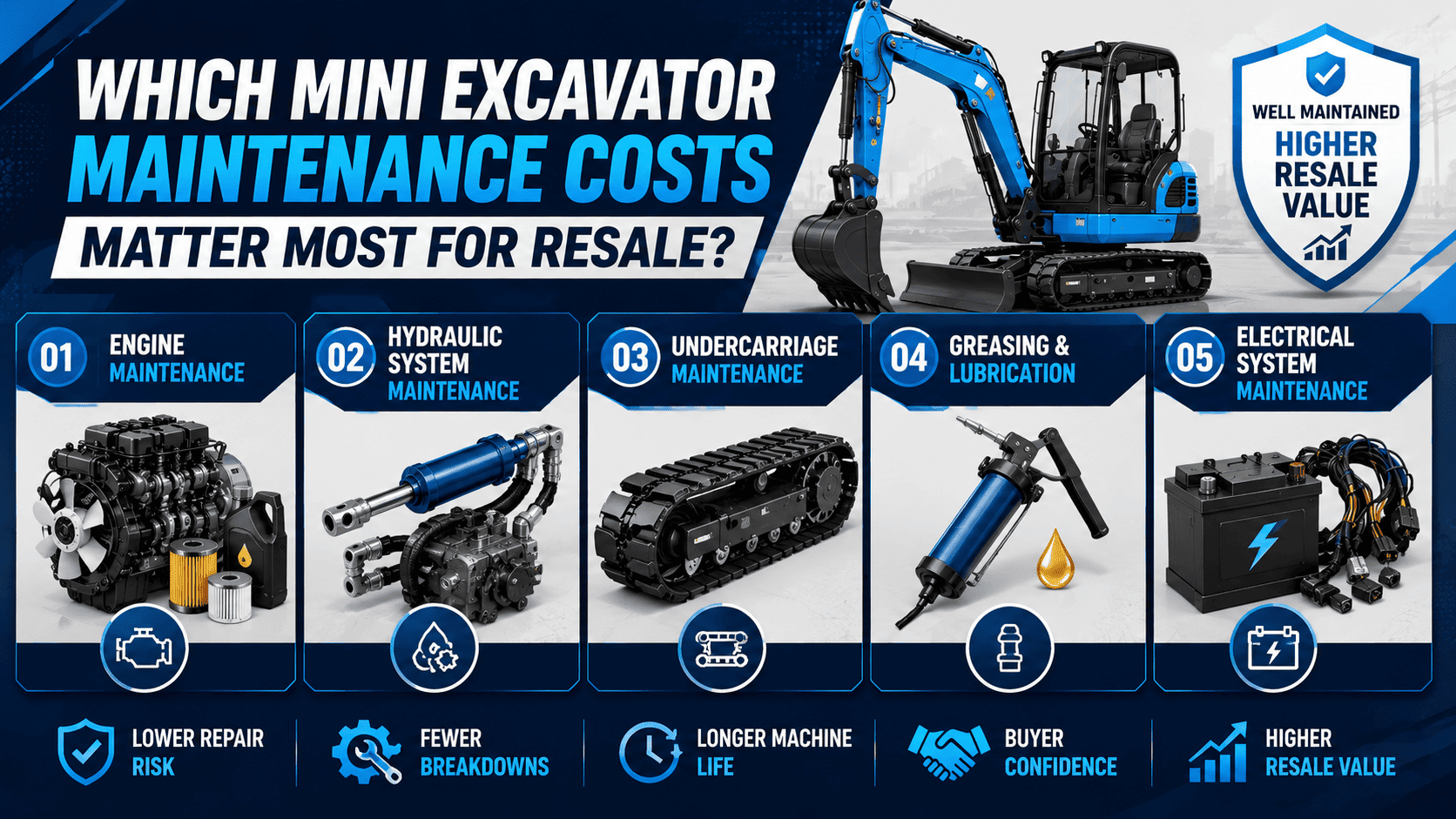
Not all maintenance carries equal weight with buyers. Some systems are cheap to inspect and expensive to ignore.
Engine Maintenance
Engine oil, oil filters, air filters, fuel filters, coolant, belts, and hoses are the baseline. None of these are glamorous, but neglecting them is how a $400 filter problem turns into a $6,000 engine repair. Buyers who hear rough idle, see blue or white smoke, or smell burnt oil during a cold start will usually walk away or lowball the offer on the spot.
Hydraulic System Maintenance
Hydraulic fluid condition, filter changes, hose integrity, cylinder seals, and fitting tightness all affect how the machine digs, lifts, and runs attachments. A mini excavator with sluggish hydraulics or visible leaks around the cylinders raises an immediate red flag, because hydraulic repairs are rarely cheap and rarely simple.
Undercarriage Maintenance
Tracks, rollers, idlers, sprockets, and track tension are where a lot of used-equipment money hides. Undercarriage wear is one of the most expensive things to replace on a mini excavator, so experienced buyers inspect it closely — checking for stretched tracks, worn rollers, and uneven wear patterns before they even look at the cab.
Greasing and Lubrication
Pins, bushings, and articulation points depend on consistent lubrication. Skipped greasing shows up as excess play in the boom and arm joints, which buyers can literally feel by rocking the attachment back and forth.
Electrical System Maintenance
Battery condition, wiring integrity, lighting, sensors, and control systems round out the picture. Electrical gremlins are frustrating for owners and a quiet deterrent for buyers, since intermittent issues are hard to diagnose after the sale.
Preventive Maintenance vs. Reactive Repairs
The difference between planning ahead and catching up after something breaks shows up clearly at resale time.
| Preventive Maintenance | Reactive Repairs |
|---|---|
| Scheduled oil/filter service | Engine failure |
| Regular lubrication | Premature pin/bushing wear |
| Track inspection | Undercarriage replacement |
| Hydraulic inspections | Major hydraulic repair |
| Cooling system maintenance | Overheating damage |
| Routine inspections | Unexpected breakdown |
Preventive maintenance generally aims to reduce the risk of larger failures—it’s not a guarantee that nothing will ever break. Machines still wear out parts, and reactive repairs are sometimes unavoidable even on well-maintained equipment. The goal isn’t zero repairs; it’s fewer surprise repairs.
Does Spending More on Maintenance Increase Resale Value?
Not necessarily. This is where a lot of owners misjudge the math.
A seller generally cannot expect to recover every dollar spent on maintenance as a line-item addition to the sale price. Buyers aren’t auditing your receipts and adding up the total. However, maintenance spending can still protect value by:
- Preventing gradual deterioration of major components
- Reducing the risk of a costly component failure
- Preserving digging and lifting performance
- Improving the machine’s overall appearance and feel
- Creating documentation that builds buyer confidence
- Making the machine easier and faster to sell
That last point matters more than owners often realize. This is the core distinction worth sitting with: protecting resale value and increasing resale value are not the same thing. Good maintenance mostly does the first. It rarely does the second in any direct, measurable way.
How Operating Hours and Maintenance Work Together
Hours alone shouldn’t determine what a used mini excavator is worth—maintenance quality changes how those hours read.
Consider two scenarios:
Low hours, poor maintenance: A machine with only 800 hours but a spotty service history, skipped filter changes, and no undercarriage attention can hide problems that haven’t fully surfaced yet.
Higher hours, excellent maintenance: A machine with 2,500 hours but complete documentation, consistent fluid changes, and a well-maintained undercarriage may run smoother and last longer than the low-hour example.
A machine with more hours but strong maintenance documentation can be more attractive to an experienced buyer than a low-hour machine with questionable service history. That doesn’t mean higher-hour machines are always the better buy—hours still matter, and remaining component life is finite. It means hours are one input among several, not the whole story.
Which Components Most Affect Mini Excavator Resale?
| Component | Why Buyers Care | Potential Resale Impact |
|---|---|---|
| Engine | Reliability/performance | High |
| Hydraulics | Digging/attachment performance | High |
| Undercarriage | Repair/replacement cost | High |
| Tracks | Wear and remaining life | Moderate/High |
| Boom/Arm | Structural condition | High |
| Pins & Bushings | Excessive play/wear | Moderate/High |
| Cab/Controls | Operator usability | Moderate |
| Electrical System | Reliability | Moderate |
| Paint/Appearance | Buyer perception | Lower than mechanical condition |
The actual impact of each component varies by machine age, condition, brand, and local market demand. A ten-year-old machine with a rebuilt undercarriage may be judged very differently than a two-year-old machine with the same undercarriage wear.
How Maintenance Records Can Increase Buyer Confidence
Organized documentation should ideally include the date of service, machine hours at the time, the work performed, parts replaced, fluids used, and who performed the work—dealer, technician, or in-house crew. Repair invoices and component replacement records round this out.
Well-organized records can make the entire selling process faster and less stressful, since buyers spend less time asking questions and more time deciding whether the machine fits their needs. That said, documentation doesn’t guarantee a higher sale price. It reduces friction and uncertainty, which can shorten selling time and support a fair asking price—but the machine’s actual condition still does most of the talking.
Maintenance Costs That Are Worth Paying
Some spending protects long-term value more reliably than other spending. Generally worth prioritizing:
- Correct fluids for the specific machine
- Genuine or manufacturer-approved filters
- Scheduled servicing on time, not delayed
- Track and undercarriage maintenance
- Prompt hydraulic leak repairs
- Cooling system upkeep
- Regular greasing
- Replacing wear components before they cause secondary damage
- Professional inspections when something feels off
Delaying necessary repairs can sometimes turn a relatively small maintenance issue into a major repair—a minor hydraulic seep ignored for months can wear a cylinder rod or contaminate the system.
Maintenance Costs That May Not Increase Resale Value
Not every dollar spent on a machine produces equivalent resale value. Examples of spending that often doesn’t pay off proportionally:
- Excessive cosmetic upgrades
- Unnecessary modifications
- Expensive accessories with limited buyer demand
- Over-customization for a niche use case
Most buyers are shopping for reliability, function, and safety—not custom paint or aftermarket add-ons they didn’t ask for. Spending focused on documented maintenance and core mechanical health tends to hold up better than spending aimed at making the machine look unique.
How Maintenance Affects Total Cost of Ownership
Maintenance decisions don’t just affect resale—they factor into the bigger picture of Total Cost of Ownership (TCO):
Purchase Price + Maintenance + Repairs + Fuel + Downtime − Resale Value
This isn’t a formal accounting formula, but it’s a useful way to think about the numbers. A machine with a slightly higher purchase price can sometimes make financial sense if it stays reliable, needs fewer reactive repairs, and holds its value better over the ownership period. Conversely, a cheaper machine with a rough maintenance history can end up costing more once downtime and repair costs are factored in.
How to Protect Mini Excavator Resale Value
A practical checklist for owners who want to keep their options open at resale time:
- Follow the manufacturer’s maintenance schedule rather than a generic interval
- Keep detailed service records, dated and organized
- Monitor operating hours and service accordingly
- Inspect the undercarriage regularly for wear and tension
- Repair hydraulic leaks promptly instead of letting them linger
- Maintain engine and cooling systems on schedule
- Grease pivots and pins properly and consistently
- Avoid unnecessary modifications that limit buyer appeal
- Keep attachments in good condition, not just the base machine
- Keep the machine clean and presentable for viewings
- Address small problems before they become major repairs
- Keep original documentation, including manuals and purchase records
What Buyers Should Check When Evaluating a Used Mini Excavator
If you’re on the buying side, a structured inspection helps you avoid surprises.
Engine: Check for a clean cold start, unusual smoke, visible leaks, or odd noises during idle and load.
Hydraulics: Look at cylinder condition, hose wear, any leaks around fittings, and how the system performs under load.
Undercarriage: Examine track condition, rollers, idlers, sprockets, and track tension for uneven or excessive wear.
Structure: Inspect the boom, arm, and bucket for cracks, weld repairs, or visible damage.
Controls: Test joysticks, travel controls, gauges, and warning indicators for responsiveness and accuracy.
Documentation: Ask for service history, maintenance records, repair invoices, and confirmation of operating hours.
For anything you can’t fully evaluate yourself—especially hydraulic or structural concerns—it’s worth bringing in a qualified technician before finalizing a purchase.
Should You Repair a Mini Excavator Before Selling It?
It depends on the numbers and the machine, not a blanket rule.
Before committing to pre-sale repairs, weigh the repair cost against the expected resale benefit, the machine’s age, its overall condition, buyer expectations for that model, and current market demand. Major repairs may not always be financially worthwhile immediately before selling—spending $4,000 to fix an issue that only adds $1,500 to the sale price doesn’t make sense.
It helps to separate necessary repairs—things that affect safety, function, or would fail a buyer’s inspection—from cosmetic upgrades that mostly appeal to your own preferences rather than the market’s.
How Maintenance Affects Used Mini Excavator Pricing
Used equipment pricing typically weighs several factors together:
Age + Hours + Condition + Brand + Model + Maintenance History + Market Demand
Maintenance history is one part of that picture, not the whole formula. Two identical machines with the same hours and age can price differently based on documented care, just as two machines with different maintenance records can price similarly if other factors—brand reputation, local demand, attachment compatibility—outweigh the service history in a buyer’s decision.
Best Maintenance Strategy for Long-Term Resale Value
A practical maintenance rhythm generally falls into three tiers:
Daily / Pre-Use: Visual inspection, fluid level checks, track inspection, and greasing where specified by the manufacturer.
Periodic: Engine oil and filter service, hydraulic system inspection, track and undercarriage checks, and cooling system inspection.
Annual / Manufacturer-Specified: Comprehensive servicing, fluid replacement as specified, and detailed component inspections.
Exact intervals vary significantly by brand, model, and duty cycle, so always follow the specific manufacturer’s maintenance schedule rather than a generic timeline pulled from a different machine.
Common Maintenance Mistakes That Hurt Resale Value
Some habits quietly erode both machine condition and buyer confidence over time:
- Skipping scheduled maintenance to save short-term cash
- Poor or nonexistent record keeping
- Ignoring hydraulic leaks until they worsen
- Neglecting track and undercarriage inspection
- Delaying repairs on known issues
- Using incorrect or off-spec fluids
- Ignoring dashboard warning indicators
- Poor storage conditions, exposing the machine to unnecessary weather damage
- Excessive modifications that narrow buyer appeal
- Selling without any maintenance documentation
Each of these either damages the machine directly or damages buyer confidence indirectly—and often both at once.
FAQs
How does maintenance cost impact mini excavator resale? Maintenance cost affects resale mainly through the condition it produces, not through a direct dollar match. Regular maintenance helps preserve engine, hydraulic, and undercarriage health, which supports buyer confidence and a stronger asking price. But spending on maintenance doesn’t automatically translate into a proportional resale increase.
Does regular maintenance increase mini excavator resale value? Not directly. Regular maintenance mainly protects the machine’s condition rather than adding value on its own. A well-maintained excavator tends to run better and show fewer red flags during inspection, which supports resale value indirectly by keeping the machine in the condition buyers expect.
Do maintenance records increase the value of a used mini excavator? Maintenance records don’t guarantee a higher price, but they reduce buyer uncertainty. Documented service history—dates, hours, parts, and technician details—helps buyers trust the machine’s condition, which can shorten selling time and support a fair asking price.
Does operating hours or maintenance matter more? Both matter together rather than separately. A higher-hour machine with strong maintenance documentation can be more attractive than a low-hour machine with a questionable service history, since maintenance quality affects how much life remains in the major components regardless of the hour count.
What maintenance should I do before selling a mini excavator? Focus on necessary repairs over cosmetic upgrades: fix hydraulic leaks, address engine issues, inspect the undercarriage, and complete any overdue scheduled service. Gather maintenance records and clean the machine for viewing. Avoid unnecessary spending that’s unlikely to be recovered at a sale.
How much does mini excavator maintenance cost? Costs vary widely by machine size, brand, age, and usage, covering fluids, filters, hydraulic service, undercarriage upkeep, and occasional repairs. Because costs depend heavily on the specific machine and its maintenance history, owners should reference their manufacturer’s schedule and a trusted dealer for accurate estimates.
Does undercarriage condition affect mini excavator resale value? Yes, significantly. Undercarriage components—tracks, rollers, idlers, and sprockets—are expensive to repair or replace, so buyers inspect this area closely. Excessive wear or damage here often has a larger impact on buyer perception than many other maintenance concerns.
Does hydraulic maintenance affect used excavator value? Yes. Hydraulic performance directly affects digging power and attachment function, so leaks, worn hoses, or sluggish response raise concerns for buyers. Consistent hydraulic maintenance helps preserve performance and reduces the chance of a costly repair discovery during inspection.
Should I repair my mini excavator before selling it? It depends on the repair cost versus the expected resale benefit. Necessary repairs that affect safety or function are usually worth addressing. Expensive repairs with limited expected return, or purely cosmetic fixes, may not be financially worthwhile immediately before a sale.
What should I look for when buying a used mini excavator? Check the engine for smooth cold starts and no unusual smoke or noise, inspect hydraulics for leaks and performance, examine the undercarriage for wear, review the structure for damage, test the controls, and request full maintenance and service documentation before deciding.